Employer examples: Vacancy-specific requirements below describe postings reviewed for the original 2026-08-31 publication. The unavailable examples are retained as historical illustrations, not open jobs: Entergy River Bend Reactor Engineer and Westinghouse Nuclear Design Engineer 1. Their links now lead to employer careers pages for a fresh search, not an archive of those jobs. Confirm all requirements against a new posting before applying.
Several months before a refueling outage, a team has to decide where every fresh and previously used fuel assembly will go in the next core. After the outage, someone must compare the reactor's measured response with the predicted response before the plant returns to full power. For the rest of the operating cycle, someone has to watch the core closely enough to catch a meaningful change before it becomes an operating problem.
That is the territory of reactor engineering.
It is one of the most analytical jobs at a nuclear power plant, but the work is not confined to a computer. Reactor engineers work with operators, fuel vendors, outage teams, chemistry, licensing, and other engineering groups. Their calculations eventually become real fuel moves, real operating limits, and real decisions in the control room.
The title can also be confusing. A reactor engineer is usually not a licensed reactor operator, and not every reactor engineer personally designs the reload core. The exact job depends on whether the position sits at a plant, in a utility's corporate fuels group, or with a fuel vendor.
If you already work at a plant, one useful way to think about the group is this: reactor engineering protects the connection between the approved core design and the core that is actually loaded and operating.
The short answer
A nuclear reactor engineer helps ensure that the reactor core behaves as designed throughout the fuel cycle.
At an operating plant, that commonly includes:
- monitoring core power distribution and fuel performance;
- tracking reactivity and comparing plant data with predictions;
- supporting control room decisions during power changes;
- maintaining fuel and core configuration records;
- preparing for refueling outages and verifying fuel moves;
- performing or evaluating startup physics tests after a reload; and
- confirming that the plant remains within approved analytical and operating limits.
In a corporate core design or fuels group, the work may focus more heavily on reload analysis. Those engineers develop core loading patterns, run reactor-physics and thermal-hydraulic models, confirm safety limits, and provide the cycle-specific information the plant will use.
The deliverable is not always a calculation. It may be a core monitoring surveillance, a reactivity plan for a power maneuver, an approved loading pattern, a startup test report, a fuel-accountability record, or a technical recommendation to operations.
Both sides of the job protect the same handoff: the analysis, the physical core, and the way the unit is operated must stay aligned.
A reactor engineer is not the same as a reactor operator
The similar titles cause plenty of confusion.
A reactor operator manipulates or supervises the operation of plant controls under an individual license issued by the U.S. Nuclear Regulatory Commission. A reactor engineer provides technical analysis and recommendations. The engineer may sit in the control room during a startup or power maneuver, but licensed operators remain responsible for operating the reactor.
A reactor engineer normally does not need an NRC operator license. The employer will have its own qualification program, and some jobs require the engineer to become a Qualified Nuclear Engineer, often shortened to QNE. QNE is a utility qualification tied to the employer's program and applicable industry standards. It is not an NRC operator license.
The distinction matters when reading job postings. A role centered on an NRC license class, simulator training, watchstanding, and control-board manipulations is probably an operator-track job. Shift work by itself is not enough to tell, because reactor engineers may cover startups and outages around the clock. A posting that emphasizes core monitoring, reactor physics, fuel management, startup testing, or reload analysis is describing reactor engineering.
The two main versions of the job
Reactor engineering work is often split between a plant team and a corporate or vendor team. Utilities organize this differently, so read the responsibilities rather than relying on the title alone.
Site reactor engineering
Site reactor engineers work closest to the operating plant. They monitor the core during the cycle, answer questions from operations, maintain fuel records, prepare surveillance or test procedures, and support the refueling outage and subsequent startup.
Their work is highly procedural. A good analysis is not enough by itself. The inputs must be controlled, independent checks must be completed, assumptions must match the current plant configuration, and the final recommendation must be usable by the people operating the unit.
Core design and corporate fuels
Core design engineers plan the next operating cycle. They evaluate possible arrangements of fresh and burned fuel, calculate expected core behavior, and demonstrate that the proposed design meets applicable limits.
A historical Westinghouse entry-level nuclear design example describes engineers joining a reload team, running core-design calculations, interpreting the results with independent verifiers, and delivering analyses to operating PWR plants. That is a better picture of the work than the phrase “run simulations” suggests. The calculation has a customer, a schedule, a formal method, and a separate verifier.
Fuel vendors also employ engineers who perform cycle design, safety analysis, methods development, and customer support. At some utilities, the vendor performs much of the detailed reload analysis while utility engineers provide design inputs and review the results. At others, the utility has a larger in-house core design organization.
Terms you will see in reactor-engineering postings
Plant postings often use familiar words in very specific ways. These are worth understanding before an interview:
- Core monitoring is the recurring comparison of measured or inferred core behavior with cycle predictions and operating limits. It is not simply watching a display.
- A reactivity plan is a reviewed plan or prediction supporting a maneuver such as a power change. Operators execute the plant procedure and retain operating responsibility.
- The Core Operating Limits Report, usually called the COLR, contains cycle-specific parameter limits developed using approved methods. It is not a substitute for the plant's Technical Specifications or the full reload analysis.
- A reload safety analysis is the controlled set of evaluations that demonstrates the proposed reload can be operated within the plant's safety basis. Different organizations may own different pieces of it.
- Startup physics testing checks selected characteristics of the as-loaded core against predictions before unrestricted power operation.
- Special nuclear material accountability means maintaining controlled inventory and location records for nuclear material. It is not the same as physical security work.
You may also see references to Technical Specifications, the Updated Final Safety Analysis Report, or UFSAR, and fuel-vendor methods. A new engineer is not expected to memorize a plant's licensing basis before being hired. The interviewer does expect you to understand that an analysis has to fit the plant's approved methods and current configuration.
What site reactor engineers actually do
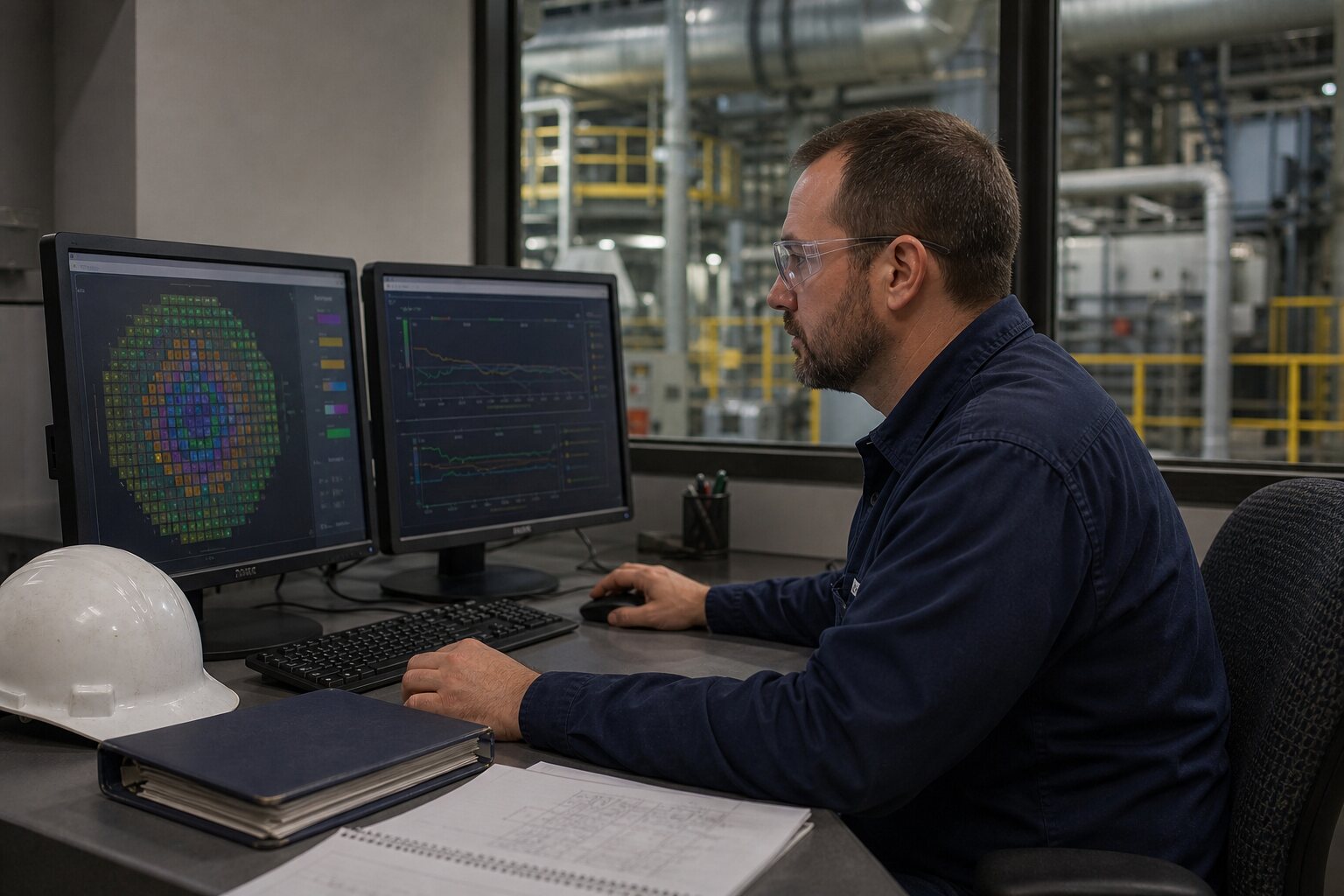
Monitor core performance
The reactor core changes gradually as fuel is used. Reactivity changes, fission products build in and decay, and the power produced in different parts of the core shifts over time. Reactor engineers compare plant measurements with the predicted behavior for the cycle.
Depending on the reactor design, that can involve in-core detector data, calculated power distributions, control rod or blade position, coolant temperature, flow, pressure, and soluble boron concentration. The exact variables differ between boiling water reactors and pressurized water reactors.
The engineer is looking for trends and consistency. A single unusual point may be an instrument issue, a data-processing problem, or a real change in core behavior. The job is to investigate methodically instead of forcing the data to fit an expectation.
Measured and predicted values are not expected to match to every displayed digit. Measurements and models both have uncertainty. What matters is whether the result meets the approved acceptance criteria, whether the trend makes physical sense, and whether any difference has been evaluated through the plant's corrective-action and engineering processes when required.
The NRC describes core design and core performance monitoring as important parts of protecting the fuel cladding barrier. Reload safety analyses establish the design basis, while startup testing and routine monitoring provide confirmation that the actual core is behaving consistently with that design.
Support power changes and reactivity decisions
Operators may need reactor engineering support before a planned power reduction, return to power, control rod sequence change, or other maneuver that affects core conditions. The engineer evaluates the proposed condition, checks the applicable limits and predictions, and provides technical guidance through approved plant processes.
This is where communication matters as much as the calculation. Operations needs a clear answer: what condition is acceptable, what should be monitored, which limit applies, and what would require stopping or changing the plan.
The engineer does not casually hand over a spreadsheet and walk away. Important recommendations are reviewed, documented, and translated into procedures, reactivity plans, or formal instructions appropriate to the site.
Prepare and evaluate startup physics testing
After a refueling outage, the plant does not simply start the reactor and immediately return to full power. Startup physics testing checks whether the newly loaded core responds as predicted.
The exact test program is plant-specific. It may include measurements related to critical conditions, control rod or control bank worth, reactivity coefficients, shutdown margin, and power distribution. Some tests are performed at very low power. Others occur during carefully controlled increases in reactor power.
Reactor engineers help prepare test procedures and predictions, brief operators, monitor the evolution, analyze results, and compare the results with acceptance criteria. If a result does not agree closely enough with the prediction, the team must understand why before moving forward.
Startup can mean long or unusual hours. The reactor reaches each test condition when plant conditions allow, not necessarily during a normal office schedule. Engineers supporting the evolution may work nights, rotating coverage, or extended shifts under the site's fatigue-management rules.
Maintain fuel and core configuration control
Fuel management is physical as well as analytical. Each assembly has an identity and history. The plant must know where it is, where it has been, how much exposure it has accumulated, and whether it is eligible for a proposed location.
Before an outage, reactor engineering reviews the approved loading pattern and supports the instructions used to move fuel. During the outage, engineers may help resolve discrepancies, verify changes, track the completed configuration, and make sure the as-loaded core matches the analyzed core.
This work leaves little room for vague handoffs. A transposed assembly identifier or unreviewed fuel move is not a clerical inconvenience. Configuration control is part of preserving the connection between safety analysis and the actual reactor.
At many sites, the group also supports special nuclear material accountability. That can include controlled records for new fuel, irradiated fuel, and material transfers. The assignment is administrative and technical, and it comes with strict procedural expectations.
Follow fuel reliability and component life
Reactor engineers may track indications associated with fuel condition, evaluate operating history, support fuel inspections, and coordinate with fuel vendors when performance questions arise. They may also maintain limits or usage records for core components whose service life depends on irradiation or operating exposure.
The goal is not only to finish the current cycle. Fuel performance data helps inform future core designs, inspection plans, and operating strategies.
How a reload core is designed
Commercial reactors do not receive an entirely new core at every outage. The NRC notes that plants generally refuel every 18 to 24 months and replace roughly one-third of the fuel. Assemblies discharged from the core go to the spent fuel pool. Fuel that will operate for another cycle may remain in place or be moved to a different core location as part of the new loading pattern.
That makes reload design a large optimization problem.
Fresh fuel provides the reactivity needed for the next cycle, but concentrating fresh fuel can create an undesirable local power peak. Previously irradiated fuel still contains usable fissile material and can help shape the power distribution. Control components, burnable absorbers, enrichment, assembly design, operating strategy, and expected cycle length all affect the result.
This is why “burned fuel” does not mean useless fuel. In core-design work, burnup is a measure of the energy produced from the fuel, not a visual description of damage. An assembly may remain in the core for several cycles while engineers track its exposure and confirm that it stays within design limits.
A simplified reload process looks like this:
- The utility establishes goals for the next cycle, including expected energy production, outage timing, operating flexibility, and fuel inventory.
- Engineers develop candidate loading patterns using fresh and previously irradiated assemblies.
- Reactor-physics models predict reactivity and three-dimensional power distribution through the cycle.
- The team evaluates thermal limits, shutdown capability, power peaking, fuel exposure, and other safety criteria using approved methods.
- Independent reviews and required safety analyses are completed.
- The final loading pattern and cycle-specific limits are transferred to the plant through controlled documents and procedures.
- After loading, startup physics tests and core monitoring check the real core against those predictions.
The software may be sophisticated, but the engineering discipline around it is just as important. Inputs need traceability. Computer codes must be used within the scope and limitations of the approved method. Changes require review. Results that look surprising need investigation, not cosmetic smoothing.
The NRC's guidance on reload analyses reflects the breadth of the work. Approved methods can cover nuclear physics, core thermal hydraulics, fuel mechanical behavior, accident and transient analysis, instrument setpoints, containment response, criticality, and statistical treatment. One engineer may not own every analysis, but the reload package depends on those pieces fitting together.
What a normal week can look like
During a stable operating cycle, a site reactor engineer's week may be less dramatic than the title suggests. That is a good thing.
A typical week might include reviewing core monitoring results, updating trend packages, preparing a calculation, answering an operations question, revising a surveillance procedure, participating in a fuel-vendor call, and completing continuing training. There may also be meetings about the next outage even while the current cycle is still underway.
The balance shifts throughout the cycle. Early in the cycle, startup results and power ascension receive close attention. Mid-cycle work may lean toward routine monitoring, procedure maintenance, and planning. As the next outage approaches, fuel receipt, loading documents, predictions, briefings, and coverage plans become more prominent.
Corporate core design work follows a different rhythm. Engineers may spend long blocks of time building and evaluating models, then enter intense review periods as a reload design approaches completion. They still work with the plant, but they are usually farther from daily operations.
The office schedule on a site posting can be misleading. Reactor engineering supports a plant that operates continuously. A current Southern Nuclear posting for Vogtle Units 3 and 4 says the group supports operations around the clock, with the advertised position taking an on-call week once every five weeks and occasionally working shifts. It also assigns the engineer to an emergency-response position in the Technical Support Center.
That exact rotation is not an industry standard, but the underlying point is common. Ask about duty coverage, callouts, outage hours, emergency-response assignments, and whether the team supports more than one unit. “Day shift” does not always mean every week ends at the same time on Friday.
How the refueling outage changes the job
Refueling outages compress a great deal of work into a short period. Fuel is moved, equipment is maintained, inspections are performed, and modifications may be installed while the unit is shut down.
For reactor engineering, outage work can include:
- checking new fuel documentation and receipt records;
- confirming the approved shuffle and loading instructions;
- providing technical coverage during fuel movement;
- documenting the final as-loaded core;
- preparing predictions and briefings for startup testing;
- supporting initial criticality and low-power physics tests; and
- monitoring the staged return to full power.
Plans sometimes change. An inspection finding, equipment problem, or schedule delay may force the team to reconsider a sequence. The reactor engineer's job is not to improvise around controls. It is to help determine what the approved analysis allows, what additional review is needed, and how to document the final configuration correctly.
PWR and BWR reactor engineering are not identical
The underlying reactor physics is shared, but the practical work differs by reactor type.
In a pressurized water reactor, soluble boron in the coolant is an important reactivity-control tool. Reactor engineers may closely track boron concentration, control bank position, temperature effects, and core power distribution.
In a boiling water reactor, the work places more emphasis on control blade patterns, core flow, and the relationship between flow and power. Monitoring methods and terminology also differ.
Plant designs within the same broad category can still use different fuel products, analytical methods, monitoring systems, procedures, and organizational arrangements. Experience transfers, but a new hire should expect a substantial site-specific qualification process. Even two PWR jobs can feel different when one is at a Westinghouse-designed plant and the other uses a different nuclear steam supply system, fuel product, or core-monitoring method.
Nearby roles that are easy to confuse
Reactor engineering overlaps with several other nuclear careers, but the ownership is different.
A nuclear plant system engineer owns the health and performance of physical plant systems such as pumps, valves, heat exchangers, electrical equipment, or instrumentation. A reactor engineer owns questions about core behavior, reactivity, fuel configuration, and cycle performance.
A nuclear licensing engineer interprets the licensing basis, prepares regulatory submittals, and coordinates with the NRC. Reactor engineers provide technical inputs when a fuel or core change affects that basis, but they do not usually own the entire submittal.
A criticality safety engineer evaluates whether fissile material outside an operating reactor remains safely subcritical during storage, handling, processing, or transportation. That specialty uses neutron physics too, but the problems and controls are different.
A fuel performance or fuel mechanical engineer focuses on how the fuel rod, cladding, and assembly respond to irradiation, temperature, stress, and chemistry. Core design engineers focus more on neutronics, power distribution, and cycle strategy, though the disciplines work closely together.
Education and qualifications employers look for
A bachelor's degree in nuclear engineering is the most direct preparation. Coursework in reactor physics, neutron transport or diffusion, thermal hydraulics, numerical methods, heat transfer, and engineering analysis maps closely to the job.
It is not the only route, but the route depends heavily on the employer. Southern Nuclear's current Vogtle site posting requires an ABET-accredited engineering degree or a professional engineer license and strongly prefers nuclear engineering. A recent Entergy site posting accepted nuclear engineering, a closely related scientific discipline or physical science, or equivalent experience. By contrast, Westinghouse's historical entry-level nuclear core design example required a nuclear engineering degree.
That difference is useful when deciding whether to apply. A mechanical, chemical, electrical, or physics graduate may be competitive for some site roles, especially with plant, Navy nuclear, research-reactor, or analytical experience. A vendor group hiring directly into neutronics design can set a narrower degree requirement because the new engineer enters specialized methods training immediately.
For computational positions, programming is genuinely useful. Python, MATLAB, FORTRAN, shell tools, and vendor-specific code systems can all appear, but no software list is universal. More important than naming a language is showing that you can verify inputs, interpret results, work within a method's limitations, and keep a calculation reproducible. Do not assume a code used in a university course is the production tool used by a particular utility or vendor.
Employers also look for habits that are harder to capture in a course list:
- careful treatment of inputs, assumptions, and units;
- willingness to stop when results do not make sense;
- clear technical writing;
- comfort receiving an independent review;
- ability to explain a complex result to operators; and
- respect for procedures and configuration control.
The Bureau of Labor Statistics says nuclear engineers typically need at least a bachelor's degree in nuclear engineering or a related field and notes that cooperative-education programs let students gain work experience while completing the degree. For this specialty, experience with a utility, reactor vendor, research reactor, naval nuclear program, or fuel organization can be especially useful.
How a new reactor engineer becomes qualified
An entry-level hire is not expected to arrive ready to approve reload calculations or direct startup testing.
The first phase usually combines site access training, nuclear safety culture, procedures, plant systems, reactor theory, design-basis familiarization, and supervised task performance. The engineer learns the plant's software, surveillance methods, fuel records, and review process. Qualification may involve written exams, oral boards, task signoffs, or demonstrated work under a qualified mentor.
Examples reviewed at publication show how much this can vary. Westinghouse placed a new nuclear design engineer into design-specific training leading toward its Nuclear Design qualification. Southern Nuclear says its site engineer must complete reactor-engineer qualification and a separate engineering orientation program that lasts about five weeks. A recent Entergy multi-level posting applied ANSI/ANS-3.1 experience requirements specifically to the senior reactor engineer level.
Read those qualification lines carefully. A standard cited for the senior level is not automatically an entry-level prerequisite. If a posting says the hire must obtain QNE after starting, ask what the qualification includes, the expected completion window, and what work you can perform under supervision before qualification.
The most important early lesson is knowing the boundary of your qualification. New engineers are expected to ask questions and use qualified reviewers. Quiet confidence is useful. Pretending to know a plant-specific answer is not.
Over time, assignments become less bounded. A developing engineer may first update routine monitoring reports, then prepare a procedure change, evaluate a power maneuver, support an outage, and eventually take lead responsibility for a test or cycle activity.
Site access is a separate gate from technical qualification. Commercial plant roles commonly require background screening, fitness-for-duty testing, and qualification for unescorted access. Some site engineers also join the emergency-response organization. Neither requirement turns the position into a security job, but both affect where you must live, your on-call obligations, and how quickly you can begin independent site work.
How to get hired without commercial nuclear experience
Start by searching broadly. The relevant title may be reactor engineer, reactor physics engineer, core design engineer, nuclear fuels engineer, core analysis engineer, or neutronics engineer. Browse current nuclear engineering jobs and search employer career sites for several of those terms.
Then make your technical preparation easy to see.
If you completed a reactor-physics project, explain the question, method, verification, and result. If you wrote code, say what it calculated and how you checked it. If your experience came from a research reactor, laboratory, Navy nuclear program, or another regulated industry, connect it to procedural compliance, conservative decision-making, configuration control, and operations support.
You do not need to claim experience you do not have. A credible entry-level story sounds like this: I understand the fundamentals, I can do controlled analytical work, I communicate clearly, and I am prepared to learn this plant's methods.
For a broader view of plant hiring, read How to Get a Job at a Nuclear Power Plant. Former service members may also find From Navy Nuke to Civilian Nuclear useful.
Make your resume show reactor-engineering evidence
Generic phrases such as “performed engineering analysis” do not tell a hiring manager much. Show the technical problem and the discipline you brought to it.
Useful resume evidence can include:
- reactor-physics, neutronics, or thermal-hydraulic analysis;
- model verification against a benchmark, hand calculation, or measured data;
- uncertainty, sensitivity, or trend analysis;
- Python, MATLAB, FORTRAN, or other computational work;
- controlled calculations, procedures, peer reviews, or configuration records;
- communication with operators, technicians, customers, or non-specialist reviewers; and
- internship or project work involving fuel, radiation, criticality, or reactor operations.
A stronger bullet is specific without pretending the student project was plant work:
Built a Python model of one-dimensional neutron diffusion, compared multiplication-factor results with an analytical benchmark, and documented input assumptions and error sources for faculty review.
Another good example for an experienced applicant is:
Evaluated equipment and operating data for abnormal trends, documented the technical basis for recommended actions, and briefed shift personnel in a regulated operating environment.
Use the language of the posting where it honestly matches your experience. If the employer asks for core monitoring and you have analyzed time-series detector data, make that connection explicit.
Questions you are likely to hear in an interview
Entry-level interviews usually test reasoning and communication more than memorized plant details.
Be ready for questions such as:
- What happens to reactivity as fuel burns through a cycle?
- Why is power peaking important?
- How would you respond if measured data disagreed with your model?
- How would you verify a calculation before it affected plant operation?
- Tell us about a time you found an error in your own work.
- How would you explain a technical limit to an operator who needs a quick answer?
- Are you able to support outages, nights, or unusual hours during startup?
For the reactivity question, avoid answering only that reactivity “goes down.” Fuel depletion matters, but so do fission-product poisons, burnable absorber depletion, temperature, control configuration, and, in a PWR, soluble boron. The interviewer is often listening for whether you recognize competing effects and state your assumptions.
For the power-peaking question, connect the physics to fuel protection. A local fuel or thermal limit can become restrictive even when average reactor power appears acceptable.
For the disagreement question, a strong answer does not immediately blame the instrument or the model. It preserves the current safe condition, confirms the data and configuration, checks assumptions and recent changes, consults procedures and qualified peers, and documents the resolution.
For experienced positions, expect deeper questions about core monitoring methods, reload design, fuel products, software, operating limits, review practices, or specific reactor technology.
Questions to ask before accepting an offer
The same title can describe substantially different careers. Ask enough questions to understand the actual assignment.
Good questions include:
- Is this a site reactor engineering role, an in-house core design role, or a utility oversight role for vendor analysis?
- Which responsibilities belong to the plant, corporate fuels group, and fuel vendor?
- What qualification program will I complete, and how long does it usually take?
- Which reactor-physics and core-monitoring tools does the team use?
- How many refueling outages or startups will I support each year?
- What does night, weekend, on-call, or emergency-response coverage look like?
- How many engineers share the duty rotation, and how often are they actually called?
- How much of the job is analysis, procedure work, fuel accountability, and operations support?
- Does the role require QNE, and which ANSI/ANS edition or site standard governs the qualification?
- What training or fleet travel is required before I can qualify independently?
- What assignments do engineers usually take after two or three years?
Also ask where the work must be performed. A corporate design job may support multiple stations from a central office, while a site role normally requires living within commuting or emergency-response distance of the plant.
What the job is really like
What draws many people to reactor engineering is the connection between first-principles physics and an operating machine. Few engineering jobs let you model neutron behavior, help verify a physical fuel configuration, and then watch plant data confirm the prediction.
The demanding part is that precision comes with responsibility. The work can involve long review cycles, conservative procedures, intense outage periods, and questions that arrive on the plant's schedule. Much of the day is careful documentation rather than dramatic problem-solving.
People tend to enjoy the role when they like analytical work but do not want to be isolated from operations. They are comfortable having their work challenged, and they care more about getting the right answer than defending their first answer.
People may struggle if they want rapid, informal experimentation or dislike documentation and independent review. Nuclear plants change deliberately. Reactor engineering is creative, but that creativity operates inside validated methods and a strong safety culture.
A practical first-month application plan
During the first week, collect 10 to 15 live postings across site reactor engineering, corporate fuels, and vendor core design. That is usually enough to see whether you are looking at one job family or three different ones with similar names. Sort them by the work described, not just the title. Note recurring degree requirements, qualification language, reactor type, experience level, duty coverage, and location requirements.
In the second week, choose two technical projects or work examples that demonstrate physics, numerical analysis, verification, or procedural discipline. Write a concise explanation of each, including what you checked and what you would improve.
In the third week, tailor your resume to the strongest role family. Practice explaining reactivity, power distribution, validation, and conservative decision-making in plain language. You should be able to speak to both an engineer and an operations manager.
In the fourth week, apply directly through employer career pages and follow up on newly posted roles. Prepare questions that reveal whether the position is truly site reactor engineering, core design, or a blend of the two. Use the Nuclear Jobs Salary Guide as context, then evaluate the whole offer, including outage schedule, location, training, progression, and responsibility.
Frequently asked questions
Does a reactor engineer operate the reactor?
Not normally. Reactor engineers analyze core behavior and support operating decisions. NRC-licensed reactor operators manipulate the controls. An engineer can later enter an operator licensing program, but it is a separate qualification path.
Does every reactor engineer design reload cores?
No. Detailed reload design may be performed by a corporate fuels group, a fuel vendor, or a combination of both. Site reactor engineers often provide inputs, review the design, maintain configuration control, support loading, perform startup testing, and monitor the core during operation.
Do reactor engineers handle nuclear fuel?
They usually do not physically move fuel. Trained fuel-handling personnel operate the equipment. Reactor engineers provide the analyzed loading pattern, technical instructions, verification, records, and support needed to ensure the fuel is placed correctly.
Is programming required?
It depends on the role. Programming is especially valuable in core design, methods, and data-analysis positions. Site roles may rely more on approved monitoring applications and controlled spreadsheets, though scripting can still be useful when allowed by site processes.
Is the job mostly theoretical physics?
No. Reactor physics is central, but plant work also includes procedures, configuration control, technical reviews, outage planning, records, and communication with operations. The strongest engineers connect the theory to those practical constraints.
Can a mechanical or chemical engineer get the job?
Yes, for plant roles whose posted requirements accept those degrees. You will be more competitive if you can show reactor-physics coursework, nuclear experience, strong analytical work, or a clear plan for closing knowledge gaps. Do not assume the same is true for every vendor core-design position. Some current entry-level design postings require nuclear engineering specifically.
The bottom line
A nuclear reactor engineer is the technical bridge between the predicted core and the operating core. The work starts well before fuel enters the reactor and continues through loading, startup, power operation, and preparation for the next cycle.
At a plant, the role centers on core monitoring, reactivity support, fuel configuration, and startup testing. In a corporate or vendor group, it may center on reload design and analytical methods. Both versions reward the same habits: sound reactor-physics fundamentals, disciplined verification, clear communication, and the willingness to investigate when real data does not match the expected answer.
That combination makes reactor engineering a strong fit for someone who wants technically deep work with a direct connection to safe plant operation.
Sources
- Entergy careers; historical River Bend example unavailable
- Southern Nuclear: Reactor Engineer at Vogtle Units 3 and 4
- Westinghouse careers; historical Nuclear Design Engineer 1 example unavailable
- U.S. Nuclear Regulatory Commission: Core Performance
- U.S. Nuclear Regulatory Commission: What Is Nuclear Fuel?
- U.S. Nuclear Regulatory Commission: Reload Analyses and Approved Analytical Methods
- U.S. Nuclear Regulatory Commission: Operator Licensing
- U.S. Bureau of Labor Statistics: Nuclear Engineers