Employer examples: Vacancy-specific requirements below describe postings reviewed for the original 2026-08-24 publication. The unavailable examples are retained as historical illustrations, not open jobs: Standard Nuclear Licensing Engineer. Their links now lead to employer careers pages for a fresh search, not an archive of those jobs. Confirm all requirements against a new posting before applying.
A plant wants to replace a pump with a newer model. The new pump fits, the calculations support it, and maintenance can install it during the next outage.
That still leaves another question: can the plant make the change under its existing approval, or does it need the Nuclear Regulatory Commission to approve something first?
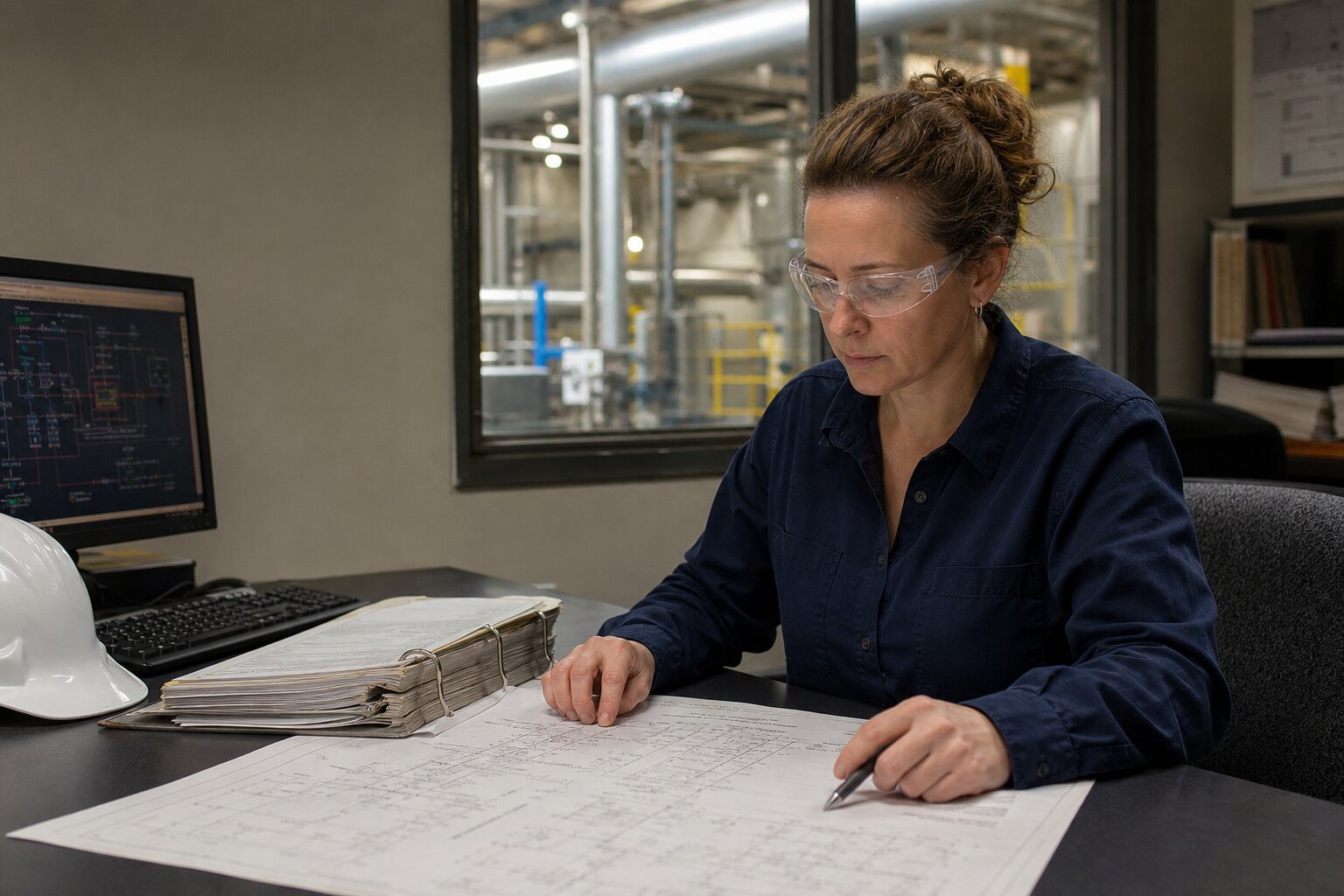
A nuclear licensing engineer helps answer that question. The engineer traces the proposed work through regulations, the facility license, technical specifications, safety analyses, prior NRC decisions, and company commitments. If prior approval is needed, licensing helps build the submittal. If the change can proceed without an amendment, licensing helps make sure the required review is complete and defensible.
The work is less visible than a control-room shift or a major equipment repair, but it affects nearly every technical department. Licensing engineers help turn engineering facts into a case that a regulator, inspector, manager, and future employee can all follow.
The short answer
A nuclear licensing engineer helps a nuclear facility obtain, maintain, and change the regulatory approvals it needs to operate or develop a project.
Depending on the employer, the job may include:
- Interpreting NRC regulations, regulatory guides, orders, and license conditions.
- Reviewing design changes, procedures, tests, and programs for licensing impact.
- Preparing license amendment requests, exemptions, topical reports, permit applications, and other regulatory submittals.
- Coordinating technical input from engineering, operations, safety analysis, environmental, security, quality, and legal teams.
- Responding to NRC requests for additional information.
- Supporting regulatory meetings, audits, inspections, and enforcement responses.
- Tracking regulatory commitments and required actions.
- Evaluating how new or revised regulations affect the facility.
- Maintaining accurate licensing-basis documents as the plant or project changes.
At an operating power plant, the work often centers on the current licensing basis and proposed plant changes. At an advanced-reactor developer, it may center on a construction permit, operating license, combined license, design approval, design certification, manufacturing license, or pre-application engagement. At a fuel-cycle facility, it may involve special nuclear material, integrated safety analysis, safeguards, transportation, environmental review, and license amendments under a different set of regulations.
The common thread is translation. The licensing engineer connects technical work to the regulatory approval that allows the work to happen.
How much authority comes with the job depends on the person's qualification and the employer's procedures. A newer engineer may research requirements, assemble technical input, and draft correspondence while a qualified reviewer checks the work. Formal submittals and regulatory positions normally pass through designated reviewers and managers. The title alone does not tell you what you are authorized to approve.
The title causes more confusion than it should
A nuclear licensing engineer is not usually an engineer who issues licenses.
The NRC issues licenses. The licensing engineer normally works for the company applying for or holding the license, or for a contractor supporting that company.
The title also does not mean the person is a licensed reactor operator. Reactor operator and senior reactor operator licenses are separate, facility-specific credentials governed by the NRC's operator licensing program.
It does not automatically mean the person is a Professional Engineer either. Some licensing engineers hold a PE license, and some postings prefer one, but there is no universal PE requirement for the role. The word licensing describes the work function, not a personal engineering credential.
You may see nearby titles such as:
- Regulatory engineer
- Licensing specialist
- Regulatory assurance engineer
- Licensing project manager
- Regulatory affairs specialist
- Nuclear regulatory affairs engineer
- Licensing lead
Some employers reserve “engineer” for candidates with an engineering degree and use “specialist” for experienced candidates with other technical backgrounds. Others use the titles almost interchangeably. Read the duties and education requirements instead of assuming the title tells the whole story.
What is the licensing basis?
People in nuclear use the phrase licensing basis constantly, but it is not one binder sitting on a shelf.
For license renewal, 10 CFR 54.3 defines the current licensing basis as the NRC requirements applicable to the plant and the licensee's written commitments for operating within those requirements and the plant-specific design basis. It includes the license and technical specifications, orders, exemptions, plant-specific design-basis information in the updated final safety analysis report, and certain docketed written commitments that remain in effect. In daily work, that information is spread across many controlled documents and years of regulatory correspondence.
Different parts of that record carry different legal and administrative weight. Not every statement in a plant document or letter is a legally binding requirement. A licensing engineer needs to identify what controls the issue, how it may be changed, and who has authority to approve the change.
That distinction matters. A statement in a safety analysis report is not automatically the same thing as a technical specification. A regulatory commitment is not automatically a license condition. A design criterion may shape an engineering decision without giving the NRC prior-approval authority over every related change.
The job is not to treat every sentence as equally binding. The job is to find the right requirement, understand why it applies, and use the correct process when the facility wants to change something.
The NRC's overview of standard review plans shows the breadth of material regulators may review, from power-reactor safety analysis reports to fuel-cycle facilities, spent-fuel storage, environmental reviews, and materials licenses. Licensing engineers learn how their facility fits into that larger framework.
What licensing engineers do at an operating nuclear plant
The exact division of work varies by utility. One site may give the licensing group direct ownership of 10 CFR 50.59 reviews. Another may qualify engineers in several departments to perform the reviews while licensing provides oversight. One fleet may centralize major submittals at a corporate office while station licensing handles day-to-day NRC interaction.
Several responsibilities show up repeatedly.
Review proposed plant changes
Engineering changes do not begin as regulatory documents. They begin as practical work: replace equipment, revise a setpoint, change a test, update a procedure, extend an inspection interval, or use a new analysis method.
Licensing helps determine how the proposal interacts with the approved plant description and applicable requirements. For many operating-reactor changes, that includes the process under 10 CFR 50.59, “Changes, tests, and experiments.” The rule allows licensees to make certain changes without prior NRC approval when the required screening and evaluation show that the regulatory criteria are not met.
This is not a shortcut around engineering. The technical work still has to be correct. The 50.59 process asks a separate question: does the proposed change cross a threshold that requires an NRC license amendment before implementation?
The current 10 CFR 50.59 rule defines the changes, tests, and experiments that may proceed without an amendment and the eight criteria that require prior NRC approval. It also requires the licensee to preserve its written evaluations and periodically report summaries of qualifying activities. A licensing engineer may perform a screening or evaluation, check another qualified reviewer's work, resolve comments, or determine that a different change-control process applies.
Prepare license amendment requests
When a proposed change requires prior NRC approval, the licensee may prepare a license amendment request, commonly shortened to LAR.
A strong LAR does not simply announce the requested change. It describes the change, explains why it is needed, identifies the affected requirements and documents, presents the technical and regulatory basis, evaluates safety impacts, and supports the findings the NRC must make.
The NRC explains that power-reactor amendment requests are governed by 10 CFR 50.90, 50.91, and 50.92. Power uprates are one visible example, but the same amendment framework applies to many other changes to a plant license or technical specifications.
Licensing rarely writes the entire technical basis alone. A system engineer may provide equipment history. A design engineer may own calculations. Reactor engineering may provide core analyses. Safety analysis may evaluate accident consequences. Operations may explain how a proposed change affects procedures and staffing.
The licensing engineer makes those contributions fit together. The finished submittal needs one consistent scope, terminology, schedule, and conclusion.
Coordinate responses to NRC questions
After reviewing a submittal, NRC staff may issue a request for additional information, or RAI. The questions may ask for a missing calculation, a clearer explanation, a comparison with precedent, or additional support for a regulatory conclusion.
An RAI response is not an ordinary email. It becomes part of the regulatory record and may shape the NRC's safety evaluation. Licensing coordinates the technical owner, reviewers, managers, legal counsel when needed, and the official transmittal process.
The work can feel deceptively simple. A question may be only three sentences long, but the answer can require several departments, controlled calculations, quality reviews, and careful checks against earlier statements. A good licensing engineer keeps the team focused on the question actually asked and makes sure the answer does not accidentally create a new inconsistency elsewhere.
Support inspections and regulatory meetings
NRC inspectors do not interact only with the licensing department, but licensing often helps organize the facility's response. That can include assembling documents, identifying subject-matter experts, tracking requests, preparing briefing materials, documenting commitments, and making sure answers are accurate and complete.
The NRC's Reactor Oversight Process uses inspections, performance indicators, assessment, and enforcement to oversee operating plants. Licensing engineers need enough familiarity with that process to understand why an inspector is asking for a document and what happens after a potential issue is identified.
Public meetings and routine regulator calls require a different skill. The engineer may need to explain a complex technical position in plain language, recognize when a statement goes beyond the approved company position, and capture action items without turning every discussion into a promise.
Control regulatory commitments
Facilities make commitments in formal correspondence and licensing submittals. Those commitments may require a procedure revision, calculation, inspection, program change, or future report by a specific date. Not every corrective action or statement of intent is automatically a regulatory commitment, and most companies limit who may make one on the licensee's behalf.
Licensing groups commonly track the actions, owners, due dates, completion evidence, and any proposed changes. This is more than calendar administration. Before changing or closing a commitment, the facility needs to understand why it was made, whether the NRC relied on it, and whether another requirement depends on it. The NRC's commitment-management summary explains this hierarchy and why commitments need controls even when they are not license conditions.
A licensing engineer who is organized but never asks technical questions can miss the point. A technically strong engineer who cannot track dates and approvals can create a different problem. The role needs both habits.
Evaluate events and reporting requirements
When something significant happens at a plant, operations and technical teams first stabilize the plant and establish the facts. The formal reportability decision and notification path are site-specific. Operations, licensing or regulatory affairs, engineering, and management may all be involved, with legal counsel consulted when appropriate. Licensing often helps document the basis and coordinate a written licensee event report.
The NRC's event reporting guidance addresses immediate notifications under 10 CFR 50.72 and written licensee event reports under 10 CFR 50.73. Not every unusual equipment condition is reportable, and reportability decisions depend on exact facts and regulatory criteria.
This work rewards calm thinking. Early information may be incomplete. The reporting clock may already be running. Licensing needs to ask precise questions, document the basis, and avoid guessing beyond what the plant knows.
Follow regulatory change
Rules, regulatory guides, generic communications, enforcement decisions, and industry guidance change over time. Licensing engineers monitor those developments and help the company decide what must change internally.
That might lead to a gap assessment, implementation plan, procedure revision, training, new inspection activity, or a determination that no action is required. Senior licensing staff may also support comments on proposed rules or industry working groups.
The hard part is not memorizing the Code of Federal Regulations. It is finding the current requirement, separating it from guidance and precedent, tracing how the facility committed to comply, and explaining what it means for the work in front of the team.
A realistic example from proposal to approval
Suppose a plant wants to replace an aging cooling-water pump with a different model.
The project may move through licensing work like this:
- Define the change. Engineering identifies the new pump, affected drawings, calculations, procedures, tests, and installation plan.
- Identify the approved requirements. The team reviews the system's safety functions, technical specifications, safety analysis report, license conditions, design criteria, and prior NRC correspondence.
- Determine the regulatory path. A qualified reviewer checks whether the activity is within the scope of 50.59, whether a detailed 50.59 evaluation is needed, and whether technical specifications or another regulation establish a different approval process.
- Perform the evaluation when needed. The team applies the regulatory criteria using the approved technical analyses. Licensing makes sure the evaluation answers the regulatory questions, not just the engineering design question.
- Choose the approval path. If the criteria allow implementation without prior approval, the facility retains the required records and completes its internal processes. If an amendment is required, licensing develops the LAR and project schedule.
- Support NRC review. Technical teams answer RAIs, revise analyses when justified, and participate in audits or meetings.
- Control implementation. The plant confirms that the approved change, final design, procedures, testing, and licensing documents remain aligned.
- Close the record. Licensing tracks commitments, updates affected documents, and preserves a clear history for future engineers and inspectors.
In this example, the licensing engineer usually does not design the pump or decide how maintenance installs it. The engineer makes sure the plant uses the correct regulatory path and that the record tells one coherent story. In a smaller organization or a combined engineering and licensing role, the same person may carry more technical scope.
Licensing work changes with the employer
The title can describe several related careers.
Operating reactor licensee
At a commercial plant or utility fleet, the job usually focuses on maintaining the current licensing basis, plant changes, technical specifications, NRC correspondence, inspections, event reporting, commitments, and license renewal activities.
A current Constellation senior regulatory engineer posting describes advanced regulatory and technical problem solving, licensing-basis management, and support for plant and fleet regulatory activities. Senior roles may expect extensive plant experience or prior SRO certification, but the duties show what the career builds toward.
Advanced-reactor developer
For a new reactor, licensing is tied directly to project development. Engineers help define a licensing strategy, prepare permit or license applications, coordinate safety and environmental content, support pre-application meetings, and keep the evolving design aligned with the case presented to the regulator.
Commercial advanced-reactor applicants can now pursue a license under Part 50, Part 52, or Part 53. The NRC's advanced-reactor pre-application guidance explains the available pathways and why early engagement matters. Part 53, which became available in April 2026, provides a risk-informed, performance-based, technology-inclusive alternative for commercial nuclear plants. Research and test reactors continue to use Part 50.
A licensing engineer on a new project may spend years helping move a design from early regulatory discussions through an application and NRC review. The difficult part is that the design may still be changing while the licensing schedule depends on complete, controlled, reviewable information. A draft application cannot get too far ahead of the actual design. Licensing engineers regularly have to identify which decisions are mature enough to support a submittal and which remain project risks.
Fuel-cycle facility
Fuel fabrication, enrichment, conversion, and related facilities are licensed under a different regulatory structure than power reactors. The NRC says a new fuel-cycle application must demonstrate safety and safeguards under requirements that can include 10 CFR Parts 30, 40, 70, 73, and 74.
The work may involve an integrated safety analysis, items relied on for safety, chemical and fire hazards, nuclear criticality safety, material control and accounting, security, and environmental review. NRC's integrated safety analysis overview shows how accident sequences and protective controls become part of the licensing case.
A historical Standard Nuclear licensing engineer example connects those requirements to the job: authoring safety analysis material, reviewing designs for regulatory alignment, preparing submittals, and working with engineering, operations, quality, and project teams.
Engineering firm or licensing contractor
Contractors may support one facility, several utility clients, or a specific application. The work can offer exposure to more regulatory issues and facility types, but it may also require travel, changing project assignments, strict billable schedules, and less day-to-day ownership of one plant.
Ask whether the role is primarily document authoring, independent review, project management, staff augmentation, or regulatory strategy. “Licensing support” can mean very different work.
Department of Energy facility
DOE nuclear facilities use safety-basis and authorization-basis processes that are not identical to NRC reactor licensing. Work under 10 CFR Part 830 may include documented safety analyses, technical safety requirements, unreviewed safety question determinations, hazard controls, and change packages. DOE describes DOE-STD-3009-2014 as an acceptable method for preparing the documented safety analysis for a nonreactor nuclear facility.
Employers may still use titles such as licensing engineer or regulatory engineer, especially when a project also touches NRC-regulated transportation, materials, or future commercial deployment. Read the posting for the actual framework. Experience with a documented safety analysis, technical safety requirements, or DOE standards can transfer well, but do not claim NRC licensing experience if your work used a different approval system.
What a normal week can look like
Licensing is document-heavy and mostly office-based, but it is not solitary work. At a plant, the engineer may walk down equipment or meet staff in the protected area to understand a change. At a fuel facility or new project, time in manufacturing, laboratory, or construction areas may be part of learning the process being licensed.
A typical week might include:
- Reviewing a 50.59 screening for a design change.
- Editing the regulatory section of a license amendment request.
- Meeting with engineering to resolve inconsistent assumptions in two calculations.
- Preparing subject-matter experts for an NRC audit call.
- Tracking responses to an RAI and checking the review schedule.
- Researching how another licensee handled a similar issue.
- Reviewing an inspection report for a potential commitment or corrective action.
- Briefing management on the risk to a regulatory milestone.
- Checking whether a revised regulation affects station procedures or programs.
- Updating a licensing-basis document after an approved change.
Some weeks are quiet enough for careful research and writing. Others are driven by an inspection, emergent plant condition, major submittal, or regulator deadline.
At a station, licensing staff may participate in an emergency response organization or need to meet a response-time requirement. New-project roles may involve travel to NRC meetings, vendor offices, laboratories, or construction sites. Corporate fleet roles are more likely to be hybrid than station roles, but the posting is the final word.
What good licensing work looks like
Good licensing work is often invisible. A change follows the right process, a submittal is internally consistent, the review stays on schedule, and an inspector years later can reconstruct why the decision was made.
The job is not to say no to every proposal. Treating guidance as a requirement or demanding prior approval when it is not needed can waste time and damage the licensing group's credibility. Missing a requirement can put the licensee outside its approved basis. The goal is a correct, traceable path, with uncertainty and schedule risk raised early enough for the team to act.
Managers tend to notice whether your screenings, evaluations, and submittals arrive on time, survive independent review, answer the question asked, and agree with their supporting calculations. They also notice whether technical owners trust you enough to bring licensing into a project before the design and schedule are locked.
The documents you will learn to navigate
You do not need to memorize every acronym before applying, but you should recognize the main document types.
- CFR: The Code of Federal Regulations. NRC requirements are primarily in Title 10.
- License and license conditions: The facility's authorization and specific conditions imposed by the NRC.
- Technical specifications: Safety limits, limiting conditions for operation, surveillance requirements, required actions, and administrative controls incorporated into a reactor license.
- FSAR or UFSAR: The final or updated final safety analysis report describing the facility, design functions, safety analyses, and methods of evaluation.
- LAR: A license amendment request submitted when prior NRC approval is required for a license change.
- SE or SER: The NRC commonly documents its technical basis for a licensing decision in a safety evaluation. A broader safety evaluation report may cover a full application or major review. DOE also uses SER for its review and approval of a facility safety basis, so the surrounding framework matters.
- RAI: A request for additional information issued during a regulatory review.
- Regulatory guide: NRC guidance describing methods the staff considers acceptable for meeting regulations.
- NUREG: An NRC technical report, guidance document, standard review plan, or other agency publication.
- Topical report: A technical report submitted for NRC review that may support more than one application or project.
- Regulatory commitment: A written action a licensee agrees to perform in docketed correspondence or another formal regulatory record and controls through its commitment process.
Knowing the acronym is the easy part. The harder skill is recognizing which document contains the controlling statement and whether the proposed work changes it.
Regulatory guides, NUREGs, industry guidance, and another plant's precedent can be persuasive without automatically being binding on your facility. A licensing engineer has to know whether a regulation, license condition, approved method, docketed commitment, or facility procedure made that guidance part of the path the facility must follow.
What qualifications do employers look for?
Most licensing engineer postings ask for a bachelor's degree in engineering or a related technical field. Nuclear, mechanical, electrical, chemical, civil, materials, and other engineering disciplines can fit. Some employers also consider physical science, safety analysis, or equivalent nuclear experience.
There are early-career openings, but many are not true zero-experience jobs. A current Constellation regulatory engineer posting asks for two years of professional experience, while its senior posting asks for six. Standard Nuclear's historical fuel-cycle example asked for three to five years in a technical engineering position. Those examples are more useful than the title: an “engineer” opening may still expect you to arrive with controlled-document, design, plant, or regulatory experience.
The degree alone does not make someone ready to work independently. Employers value experience with:
- Nuclear plant systems, design, operations, or safety analysis.
- Regulations, codes, standards, and controlled technical documents.
- Design-change or configuration-management processes.
- Technical writing that has passed formal review.
- Quality assurance and corrective-action programs.
- Project schedules, review cycles, and action tracking.
- Presenting technical positions to managers, clients, auditors, or regulators.
You generally do not need an operator license or PE license to enter the field. An SRO license or certification can be valuable for senior utility positions because it demonstrates plant knowledge and operational judgment. A PE can help in consulting or technical leadership paths. Neither replaces licensing experience.
There is also no single private “nuclear licensing engineer certification” that guarantees employment. Be cautious about paying for a course before checking actual postings. Employers usually care more about credible technical experience, writing, regulatory judgment, and their own qualification process.
The Bureau of Labor Statistics nuclear engineer profile provides the broader education and occupation context. For nuclear-specific compensation, compare the entire offer using the Nuclear Salary Guide, including bonus, benefits, overtime, relocation, and work location.
How to enter licensing without prior licensing experience
Licensing is often a person's second technical role rather than the first job after school. That is not a rule, but it explains why many postings ask for experience even when the title is not senior.
Start in plant or design engineering
System, design, component, project, and safety-analysis engineers already work with controlled documents, design requirements, plant changes, and formal reviews. Those habits transfer directly.
If you are considering plant engineering first, our guide to what nuclear plant system engineers do explains one common route to plant knowledge.
Move from operations, training, or procedures
Operators and operations instructors understand how requirements affect real plant decisions. Procedure writers learn document control, technical review, and precise language. An SRO background can be especially useful in plant licensing, although it is not the only route.
Bring experience from another regulated industry
Power generation, aerospace, defense, pharmaceuticals, chemical processing, medical devices, and other regulated industries can build relevant skills. The strongest bridge is not simply “worked in compliance.” Show what you actually did: interpreted requirements, prepared controlled technical documents, supported audits, resolved findings, managed commitments, or evaluated changes.
Apply to junior and supporting roles
Search beyond the exact title “licensing engineer.” Useful entry titles can include regulatory analyst, licensing specialist, junior regulatory engineer, licensing project coordinator, regulatory affairs engineer, and nuclear engineer within a licensing group.
Contractors and new projects sometimes offer a faster way to touch licensing products, while operating plants may offer deeper facility knowledge and a clearer long-term qualification path. Neither is automatically better. Choose based on the work you will own and the people available to review and teach it.
Use public documents to build familiarity
You can learn the structure of the work without pretending to have done it professionally.
Pick one operating plant or active application. Read a recent NRC inspection report, license amendment request, RAI response, and safety evaluation. Note how the applicant states the request, cites requirements, separates facts from conclusions, and answers the regulator's question.
Do not copy proprietary language into a portfolio. Use public documents to learn how regulatory writing works and to ask better interview questions.
Our broader guide to getting hired at a nuclear power plant covers access, aptitude tests, applications, and interviews across more career lanes.
How to make your resume look relevant
Licensing managers need evidence that you can handle technical detail without losing control of the larger issue.
Weak resume language hides that evidence:
Responsible for regulatory compliance and engineering documentation.
Stronger language names the work and your responsibility:
Prepared and reconciled design-change screening packages against controlled design and licensing-basis documents, resolving reviewer comments before implementation approval.
Another weak version:
Worked with regulators and internal teams.
A clearer version:
Coordinated engineering, operations, and quality inputs for three formal regulator responses, maintained the action schedule, and verified that final submittals matched approved calculations.
If you do not have nuclear experience, translate honestly:
Interpreted federal aviation requirements for equipment modifications, authored compliance findings, and supported customer audits in an AS9100 quality program.
Useful resume details can include:
- The regulations, codes, standards, or approved programs you applied.
- The document types you authored, reviewed, or controlled.
- Your role in screenings, evaluations, submittals, audits, or inspections.
- The technical disciplines you coordinated.
- The size and schedule of the project.
- How you handled comments, findings, or conflicting inputs.
- Whether your work required independent review or quality-assurance controls.
- The result, stated without claiming approval authority you did not have.
Avoid stuffing the resume with NRC acronyms you cannot explain. One accurate example of a difficult review is more convincing than a dense list of regulations copied from a job posting.
Questions you may hear in an interview
Licensing interviews often test judgment and communication more than memorized rule numbers.
Prepare examples for questions such as:
- Tell us about a time you interpreted an ambiguous requirement.
- How do you respond when two technical groups give you inconsistent information?
- Describe a controlled document you authored or substantially reviewed.
- How do you make sure a final submittal agrees with its supporting calculations?
- Tell us about a missed requirement or error you found. What did you do?
- How would you handle a regulator question when the technical answer is not yet complete?
- Describe a deadline that depended on several reviewers and subject-matter experts.
- When should an issue be elevated to management or legal counsel?
- How do you explain a regulatory risk to someone who wants a simple yes-or-no answer?
A strong answer shows your process. Explain how you established the facts, found the controlling requirement, involved the right technical owner, documented assumptions, resolved comments, and stopped when you did not have enough information.
Do not bluff through a regulation you have never used. It is better to say how you would research and verify the answer than to invent certainty.
Questions to ask before accepting a licensing job
The same title can produce very different careers. Ask:
- Which licenses, permits, or facilities will I support?
- Is the work for an operating site, a fleet office, a new application, or several clients?
- How much of the job is authoring, independent review, coordination, and regulatory strategy?
- Who owns 50.59 reviews, commitments, event reporting, and NRC correspondence?
- Will I interact directly with the NRC or work through a licensing lead?
- What formal qualification or mentoring process will I complete?
- Which technical departments will I work with most often?
- What are the largest licensing milestones in the next two years?
- How often do inspections, outages, or emergent issues change the schedule?
- Is travel expected for audits, meetings, client sites, or construction support?
- Does the role require unescorted plant access, a DOE clearance, export-control eligibility, or emergency-response duty?
- What positions do licensing engineers commonly move into next?
For help interpreting access language, read our guide to commercial plant access and DOE clearances.
A practical first-month application plan
If licensing interests you, spend the next month building evidence instead of collecting acronyms.
- Search at least six titles: licensing engineer, regulatory engineer, licensing specialist, regulatory assurance, regulatory affairs, and licensing project manager.
- Save 15 relevant postings and note which regulations, facility types, documents, and experience requirements repeat.
- Read the NRC's licensing overview, then learn the purpose of 10 CFR 50.59 and 50.90 before trying to memorize details.
- Choose one public licensing action and read the licensee request, at least one NRC question, the response, and the final safety evaluation.
- Rewrite three resume bullets to show requirement interpretation, controlled writing, review coordination, or audit support.
- Prepare two interview stories: one about resolving conflicting technical information and one about finding a requirement or error before approval.
- Apply to roles where your existing technical background matches the facility, even if your current title does not include “licensing.”
Licensing can be a good fit if you want technical work but would rather connect calculations, procedures, and requirements than spend most of the day owning one analysis or component. You have to enjoy reading closely, writing clearly, asking uncomfortable questions, and keeping a complicated approval path moving without skipping steps.
The best licensing engineers are not human search engines for regulations. They understand the facility well enough to know why a requirement matters, and they communicate well enough to help the organization act on it.
If that sounds like work you would enjoy, browse current nuclear engineering jobs and look beyond the title. The right opening may be filed under licensing, regulatory affairs, compliance, safety analysis, or project engineering.