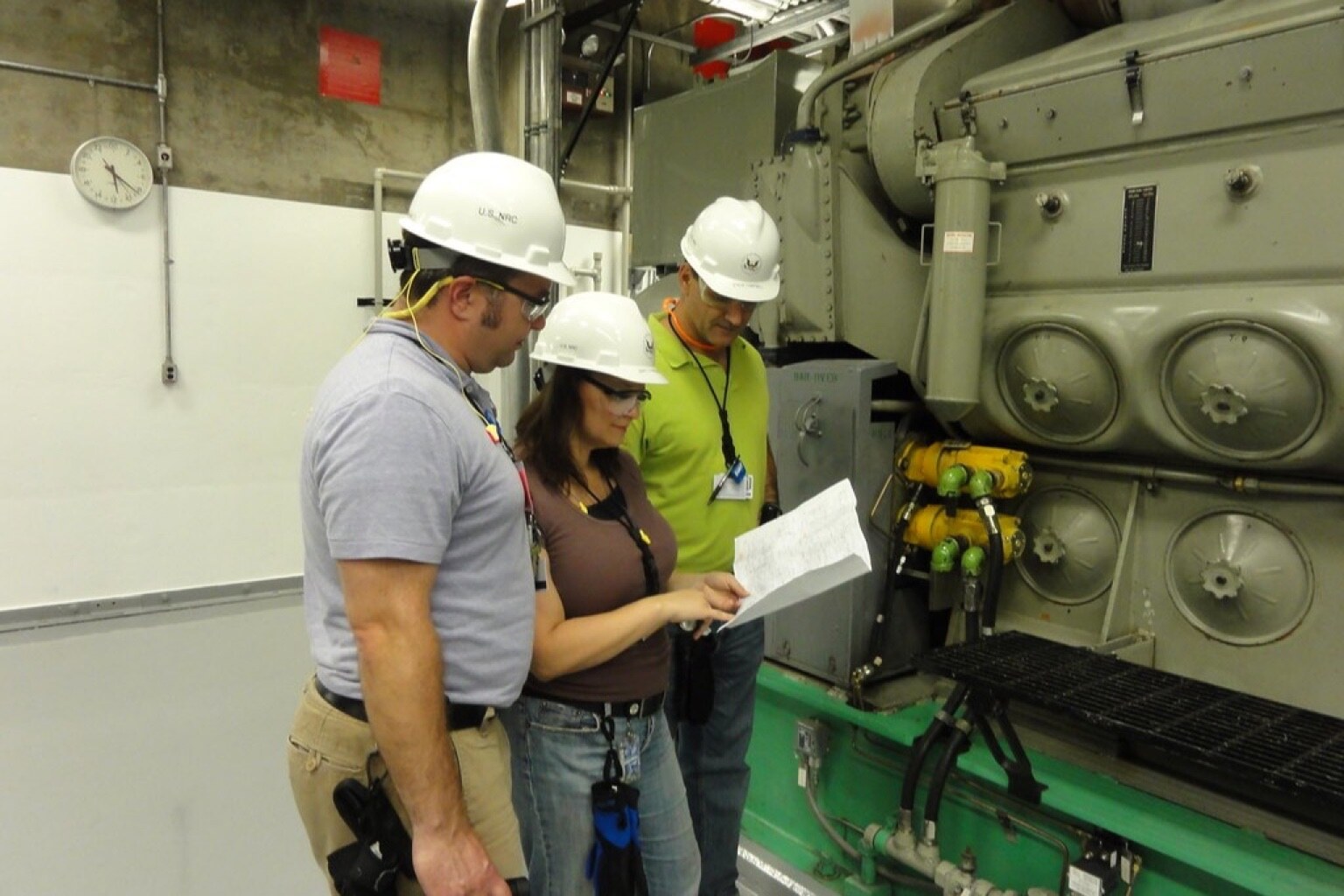
Photo: U.S. Nuclear Regulatory Commission, licensed under CC BY 2.0.
The hardest part of finding a nuclear power plant job is often knowing what to search for.
People hear “nuclear plant” and picture reactor operators and nuclear engineers. Those jobs matter, but a plant also needs electricians, mechanics, instrumentation and controls technicians, radiation protection technicians, chemists, planners, schedulers, security officers, trainers, project managers, and administrative staff.
You may already have experience that fits one of those roles, even if you have never worked in nuclear power.
The key is to stop thinking of “nuclear” as one profession. First, identify the work you are qualified to do. Then look for that work inside a nuclear organization and learn which plant-specific requirements you still need to meet.
The short answer: You can get a job at a nuclear power plant without previous nuclear experience. Your strongest entry point will usually be the nuclear version of work you already know, whether that is operations, engineering, maintenance, construction, chemistry, security, project controls, or another specialty.
Why nuclear experience is not the only way in
The U.S. nuclear energy sector employed about 70,100 workers in 2025 across nuclear electric power generation and nuclear fuels, according to the Department of Energy's 2026 U.S. Energy & Employment Report. Of those workers, 60,300 were in electric power generation and 9,800 were in nuclear fuels. Nuclear electric power generation added 2,300 workers, growing 4% from 2024. DOE's survey also found at least some hiring difficulty among 62% of nuclear electric power generation employers in manufacturing and wholesale trade, and 65% of nuclear fuels employers.
That does not mean nuclear jobs are easy to get. Employers still have to meet strict technical, safety, and regulatory requirements. It does mean the industry needs people with many different backgrounds.
DOE has also reported that most nuclear careers do not require a four-year degree. Some jobs require a bachelor's degree. Others are built on an associate degree, apprenticeship, trade qualification, military training, related industrial experience, or an employer training program.
So your first question should not be, “How do I get into nuclear?” A better question is, “Which nuclear role best fits what I can already do?”
Choose the right nuclear career lane
Start with the description that sounds most like your background. Job titles and minimum requirements vary by employer, so always read the full posting before you apply.
Engineering. If your background is mechanical, electrical, civil, chemical, or nuclear engineering, explore systems, design, project, licensing, safety analysis, and I&C roles. Highlight experience with industrial systems, regulated work, technical writing, design codes, or internships.
Operations. Experience in power generation, Navy nuclear programs, process operations, or industrial operations may translate to equipment operator, auxiliary operator, non-licensed operator, or operator trainee positions. Plant systems, shift work, procedure use, and mechanical aptitude are especially relevant.
Technical work. An associate degree or technical program may prepare you for I&C, chemistry, radiation protection, electrical, electronics, or nuclear technician jobs. Bring attention to laboratory work, instrumentation, electronics, radiation, or industrial maintenance experience.
Skilled trades. Electricians, mechanics, millwrights, welders, pipefitters, and other tradespeople should look at plant maintenance, inspection, and outage work. Apprenticeships, journey-level credentials, industrial safety experience, and code qualifications can all strengthen an application.
Planning and project work. A background in construction, planning, scheduling, or project management can lead to outage planning, scheduling, project controls, work control, and field coordination. Employers may value Primavera P6, work packages, cost controls, and experience with industrial projects or turnarounds.
Military, law enforcement, or security. Depending on your duties, your experience may fit nuclear security, emergency preparedness, operations, or maintenance. Be specific about your training, qualifications, technical responsibilities, and leadership experience.
Laboratory, environmental, quality, or safety work. These backgrounds may transfer to chemistry, environmental compliance, radiation protection, quality, or industrial safety. Relevant experience includes sampling, procedure use, instrumentation, audits, regulatory records, and corrective actions.
If two lanes fit, explore both. If none fit yet, skip ahead to the section on building a bridge into the industry.
Operations and reactor operator careers
Operations attracts a lot of interest because licensed reactor operators are highly trained and well paid. But most people do not walk into a plant and start in a licensed control room position.
The Bureau of Labor Statistics says nuclear power reactor operators typically begin as unlicensed operators. They learn the plant and gain experience before entering the licensing process. Entry-level titles may include:
- Non-licensed operator
- Nuclear equipment operator
- Auxiliary operator
- Plant equipment operator
- Nuclear operator trainee
- Reactor operator development candidate
Minimum qualifications vary widely. One employer may accept a high school diploma plus relevant industrial experience. Another may prefer an associate degree, a bachelor's degree, power plant experience, or Navy nuclear training. Treat the job posting as the final word.
Operations can be a good fit if you like learning complex systems, following procedures carefully, communicating clearly, and staying focused during long shifts. Expect rotating schedules, recurring exams, continuing training, and a high level of accountability.
Licensed operators must meet training, experience, and medical requirements and pass the Nuclear Regulatory Commission exam. The license belongs to a specific facility, so an operator moving to another plant must qualify for a new license there.
Browse current nuclear operations jobs.
Engineering jobs at nuclear plants
Nuclear plants hire far more than nuclear engineers. Common disciplines include mechanical, electrical, civil, structural, chemical, instrumentation and controls, fire protection, systems, project, and licensing engineering.
The Bureau of Labor Statistics says entry-level nuclear engineering work commonly requires a bachelor's degree in engineering, engineering technology, or physical science. Individual employers may accept several engineering disciplines when the work does not specifically require a nuclear engineering degree.
If you have an engineering degree but no nuclear experience, do not describe yourself as starting from zero. Show how your current work transfers. Useful examples include:
- Pumps, valves, heat exchangers, rotating equipment, electrical distribution, or control systems
- Design calculations, technical specifications, and independent reviews
- Failure analysis, root-cause evaluation, and corrective actions
- Configuration and change management
- Codes, standards, quality programs, and controlled documents
- Experience in power generation, chemicals, oil and gas, aerospace, defense, or manufacturing
Make those connections explicit on your resume. A hiring manager should not have to guess why your experience with a process plant, safety-critical design, or controlled documentation is relevant.
Browse current nuclear engineering jobs.
Technician, radiation protection, and chemistry roles
Technician jobs can offer a practical route into nuclear work without a four-year engineering degree. Search for specific specialties, not only “nuclear technician.” Relevant titles may include:
- Radiation protection or radiological control technician
- Health physics technician
- Chemistry technician
- Instrumentation and controls technician
- Electrical or electronics technician
- Nondestructive examination technician
The Bureau of Labor Statistics says nuclear technicians typically need an associate degree in nuclear science or a related technology. Some people enter with a high school diploma or nondegree credential plus military, apprenticeship, or other relevant experience. Once hired, technicians commonly complete extensive onsite training.
Requirements depend on the job. A permanent utility position, national laboratory role, fuel-cycle facility, and temporary outage assignment may all expect different qualifications. Some employers want established nuclear credentials. Others advertise trainee roles or accept related experience in laboratories, electronics, instrumentation, industrial hygiene, or hazardous materials.
Browse radiation protection jobs, nuclear chemistry jobs, and nuclear I&C jobs.
Maintenance, construction, and skilled trades
A nuclear plant relies on many of the same crafts as any other large industrial site. The difference is the added emphasis on training, documentation, access, quality, and procedure use.
Plants and contractors hire industrial electricians, instrumentation technicians, millwrights, machinery mechanics, welders, pipefitters, boilermakers, carpenters, scaffold builders, valve technicians, HVAC technicians, and inspection specialists.
Relevant experience may come from fossil power, hydroelectric plants, refineries, chemical facilities, shipyards, manufacturing, construction, or military maintenance. For these jobs, an apprenticeship, journey-level status, trade license, union qualification, or specialty certification may matter more than a four-year degree.
Some workers get their first nuclear experience during a refueling outage. Outages bring contractors onsite for inspections, maintenance, modifications, radiation protection, planning, and support. They can be a good entry point, but they are not a shortcut around trade qualifications, training, or plant access requirements.
Before accepting an outage job, look beyond the hourly rate. Ask about the schedule, expected overtime, assignment dates, per diem rules, travel pay, lodging costs, completion bonuses, and whether any payment depends on staying through the end of the project.
Browse current nuclear maintenance jobs or all nuclear job listings.
Project controls, quality, safety, and support work
Not every nuclear employee operates or repairs equipment. Plants, outages, and major projects also need people who can plan work, control costs, maintain records, coordinate vendors, verify quality, train employees, and manage compliance.
Search for terms such as:
- Planning, scheduling, work control, and outage planning
- Project controls, cost estimating, and field coordination
- Procurement, contracts, and vendor management
- Quality assurance and quality control
- Nuclear safety and regulatory compliance
- Training and instructional design
- Emergency preparedness
- Document control and records management
- Cybersecurity and physical security
These jobs can be a natural bridge for people from utilities, construction, aerospace, defense, pharmaceuticals, government contracting, or other highly controlled industries.
Browse nuclear project controls jobs and nuclear safety and quality jobs.
What “no nuclear experience” really means
There is a big difference between having no nuclear experience and having no relevant experience.
An industrial electrician may already understand motors, switchgear, lockout/tagout, and controlled maintenance. A refinery operator may know process systems, shift turnover, permits, and procedure use. An aerospace engineer may have experience with safety-critical designs and configuration control. A recent graduate may have the right education but need a trainee role, internship, or co-op to get started.
When you evaluate a job, ask yourself three questions:
- Can I do the underlying work? Look for a match in technical, trade, operational, or professional skills.
- Can I work in a controlled environment? Think about safety, documentation, procedures, quality, and accountability.
- Can I complete the employer's qualification process? Consider training, testing, shifts, travel, medical requirements, and access authorization.
If the answer to the first question is no, you probably need a bridge before you apply. That bridge might be an apprenticeship, technical degree, utility trainee program, industrial maintenance job, laboratory role, or related position with a nuclear contractor or equipment vendor.
Show the value of your existing experience
Hiring managers cannot give you credit for experience they cannot see. A resume filled with broad phrases makes it harder for them to connect your background to the job.
Instead of writing:
Responsible for maintenance and safety.
Show the equipment, process, and responsibility:
Performed preventive and corrective maintenance on motor-operated valves and industrial pumps using controlled work packages, lockout/tagout, and post-maintenance testing.
Instead of:
Worked on engineering projects.
Try something specific:
Prepared electrical calculations, equipment specifications, and design-change packages for safety-critical facility upgrades, coordinating independent reviews and field implementation.
Strong resumes for nuclear work often show experience with procedures, formal documentation, stop-work responsibility, independent verification, root-cause analysis, lockout/tagout, quality assurance, shift turnover, technical training, and recurring qualifications.
Use nuclear terms only when they accurately describe work you have done. Clear, honest detail is more persuasive than borrowed jargon.
What to expect during the hiring process
The process varies by employer and role, but these are the stages you are most likely to encounter.
1. Minimum qualification review
A recruiter checks your education, experience, licenses, certifications, work authorization, location, and schedule availability against the posting. Answer screening questions accurately. If a qualification is listed as required, assume the employer means it.
2. Aptitude testing
Some utilities use Edison Electric Institute employment tests. Common test batteries include:
- POSS for power plant operator roles
- MASS for maintenance and craft roles such as mechanic, machinist, electrician, welder, and pipefitter
- TECH for technical roles such as laboratory, chemistry, drafting, and estimating work
- CAST for certain construction and skilled-trade jobs
Not every employer uses the same test. If you receive an invitation, use the official preparation material from the employer or test administrator. Practice with the real time limits instead of relying only on untimed sample questions.
3. Interviews
Expect questions about safety, procedure use, teamwork, technical judgment, mistakes, and times when you stopped or corrected work.
Prepare a few honest examples in advance. Explain the situation, your responsibility, what you did, and what happened. Strong answers show that you communicate problems early and take responsibility for your decisions.
4. Conditional offer and site requirements
An offer may remain conditional until you complete medical, testing, background, access, or qualification requirements. Read the offer carefully, follow instructions, and ask the recruiter when something is unclear.
What access authorization involves
Access authorization at a commercial nuclear power plant is not automatically the same as a federal security clearance.
The NRC requires each licensed nuclear power plant to maintain a program for people who need unescorted access. Depending on the access needed, the process can include checks of identity, employment, military service, criminal history, credit history, and education. It can also include reference interviews, fingerprinting, drug and alcohol screening, and a psychological assessment.
The plant licensee, not the NRC, makes the access decision. Contractors and vendors may go through the same program as utility employees.
Complete every form carefully. Account for requested periods of employment and unemployment, and answer truthfully. A missing or inconsistent answer can create a problem even when the underlying situation could have been explained.
Do not reject yourself based on something you heard online. The NRC says a criminal conviction alone does not automatically prevent someone from receiving access authorization. Give complete information and let the licensee evaluate it under its program.
Where to find nuclear power plant jobs
The company advertising a job may not be the company whose name appears on the plant. Nuclear work is posted by:
- Plant owners and operating utilities
- Engineering, procurement, and construction firms
- Equipment manufacturers and reactor vendors
- Maintenance and outage contractors
- Staffing firms
- National laboratories and federal contractors
- Fuel-cycle, waste, and decommissioning companies
- Advanced-reactor developers
Search by job title, specialty, company type, facility, and location. If relocation is possible, browse nuclear jobs by state. If you know your specialty, browse jobs by nuclear discipline. You can also review all current nuclear job listings.
Mistakes that make the search harder
Applying to every job with “nuclear” in the title
Focus first on jobs where your education or experience meets the underlying work. Ten well-matched applications are usually more useful than dozens of unrelated ones.
Treating required qualifications as suggestions
Preferred qualifications leave room for judgment. Required degrees, licenses, certifications, or experience often do not.
Using a generic resume
Name the equipment, systems, tools, procedures, regulations, and responsibilities that transfer to the target role. Create separate resume versions if you are applying in two different career lanes.
Paying for training before checking real jobs
Do not assume a private course guarantees employment. Review current postings first, note which qualifications appear repeatedly, and verify that employers recognize the program before you spend money.
Ignoring the schedule and location
Plant work can involve rotating shifts, nights, weekends, holidays, callouts, outages, and full-time onsite work. Make sure you can accept the job as it actually exists.
Comparing offers by base pay alone
Look at overtime, shift differentials, per diem, travel, bonuses, benefits, assignment length, and schedule. Our Nuclear Salary Guide explains how those pieces affect total compensation.
A practical 30-day plan
You do not need to solve your entire career in one month. You do need to finish the month with a clearer target and stronger applications.
Week 1: Choose one or two lanes
Save 15 to 20 postings that fit your background. Include recently closed postings if necessary. Highlight the requirements, tools, and credentials that appear more than once.
Week 2: Rewrite your resume around evidence
Move relevant equipment, systems, procedures, certifications, shift work, and safety responsibilities near the top. Replace vague claims with specific examples. Build a separate resume for each genuinely different career lane.
Week 3: Close one real gap
Use the postings to choose the gap. You might renew a required trade credential, prepare for an aptitude test, learn scheduling software named in several project-controls jobs, or finish an application for a technical program.
Avoid collecting certificates simply to feel busy. Work on something employers are actually requesting.
Week 4: Apply with focus
Apply where you meet the minimum qualifications. Track each application and save a copy of the posting. Prepare examples for safety and procedure questions. If relocation is realistic, widen your search to other plants and states.
Frequently asked questions
Do you need a degree to work at a nuclear power plant?
No. Engineering and some professional roles typically require a bachelor's degree. Technician jobs often favor an associate degree. Operations, maintenance, construction, security, outage, and support roles may accept technical education, apprenticeships, military experience, trade qualifications, related industrial experience, or employer training. The individual posting controls.
Do you need a nuclear engineering degree?
Only when the role specifically requires one. Nuclear employers also hire mechanical, electrical, civil, structural, chemical, software, systems, and I&C engineers, along with many non-engineering professionals and tradespeople.
Do you need Navy nuclear experience?
No. Navy nuclear experience is valuable for many operations and technical jobs, but it is one path among several. Civilian power generation, industrial operations, engineering, technical education, apprenticeships, other military specialties, and trainee programs can also lead to nuclear work.
Is a nuclear plant background check the same as a security clearance?
Not necessarily. Commercial plants use NRC-required access authorization programs for unescorted access. Some Department of Energy, national laboratory, defense, or classified jobs may separately require a federal security clearance. Read the posting carefully.
What is the easiest nuclear job to get?
There is no single easiest role. The most attainable job is usually the one closest to qualifications you already have. For one person that may be an operator trainee opening. For someone else it may be electrical maintenance, engineering, chemistry, project controls, security, or temporary outage work.
Start with what you already know
You do not need to reinvent yourself to work in nuclear power. You need to find the role where your current experience makes sense, explain that experience clearly, and prepare for the parts of the hiring process that are specific to the industry.
Choose a career lane. Compare real postings. Let repeated employer requirements tell you what to do next.
Browse current nuclear jobs or get new nuclear job listings by email.
Sources
- U.S. Department of Energy: 2026 U.S. Energy & Employment Report
- U.S. Department of Energy: 7 Nuclear Careers that Don't Require an Engineering Degree
- U.S. Bureau of Labor Statistics: Nuclear Engineers
- U.S. Bureau of Labor Statistics: Nuclear Technicians
- U.S. Bureau of Labor Statistics: Power Plant Operators, Distributors, and Dispatchers
- U.S. Nuclear Regulatory Commission: Access Authorization Programs
- U.S. Nuclear Regulatory Commission: Frequently Asked Questions About Access Authorization
- Edison Electric Institute: Employment Test Batteries