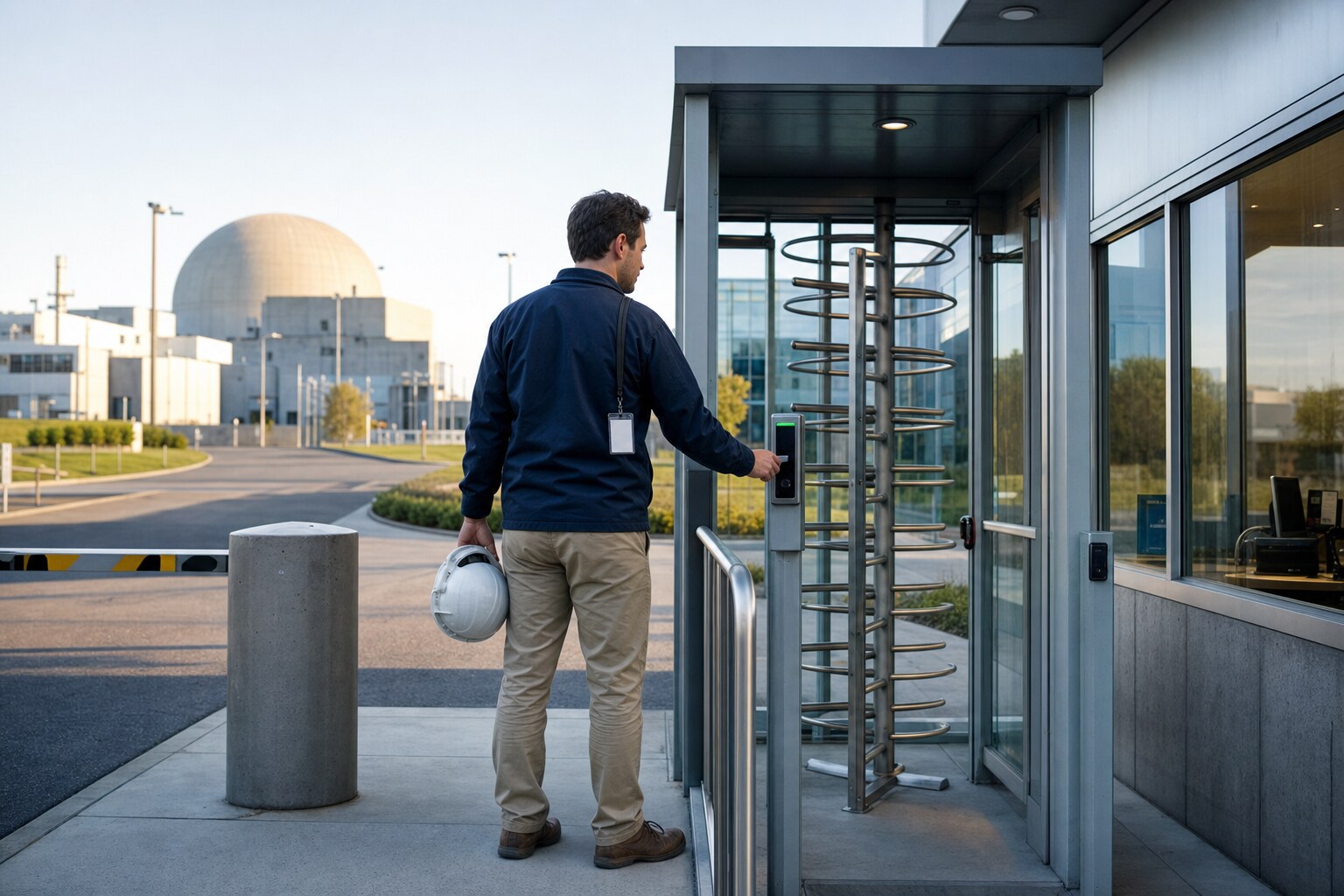
A nuclear power plant posting says you must be able to obtain "unescorted access." A national laboratory posting mentions a Q clearance. A contractor asks whether you can meet site access requirements.
Those phrases sound interchangeable. They are not.
Most jobs at commercial nuclear power plants do not require a federal security clearance. Many do require the plant to approve you for unescorted access after a background investigation, psychological assessment, and drug and alcohol screening. Some jobs connected to the Department of Energy, the National Nuclear Security Administration, national laboratories, weapons facilities, or special nuclear material may instead require a federal L or Q access authorization.
Knowing the difference can save you from rejecting a good job because the wording sounds more intimidating than it is. It can also keep you from treating a serious condition of employment like a routine badge check.
The practical rule: "Unescorted access" at a commercial power plant usually refers to the plant's NRC-regulated access authorization program. "L clearance" or "Q clearance" usually refers to a federal DOE access authorization. The job posting and hiring organization determine which process applies.
The short answer
No, not every nuclear job requires a security clearance.
The requirement depends on the facility, the employer, the work, and the information or material you would need to access.
At a commercial nuclear power plant, a posting may say you must be able to obtain unescorted access authorization. This means the plant licensee must find you trustworthy and reliable before allowing you to enter protected or vital areas without an escort. It is not the same as granting you access to federal classified information.
For DOE, NNSA, weapons-complex, or certain national laboratory work, the position may require an L or Q access authorization. These are federal security clearances tied to classified matter or certain special nuclear material.
At a nuclear vendor, engineering office, manufacturer, or remote employer, you may only need the employer's background check or a customer site badge. Some positions have no nuclear-site access requirement at all. It depends on where you will work and what you will need to enter or handle.
Even inside one company, two jobs can have different requirements. An engineer who works from a corporate office may not need plant access. A field engineer supporting an outage at the same company may need unescorted access. A scientist at a national laboratory may work only on unclassified research, while a colleague in the next building needs a Q clearance.
Read the requirement attached to the specific job. "Nuclear" by itself does not tell you which screening process applies.
Why the terminology is confusing
The phrase access authorization is used in two different nuclear employment systems.
At a commercial nuclear power plant, access authorization usually means the NRC-required process a licensee uses before granting unescorted access to protected and vital areas. This is a site security and trustworthiness determination. It is not automatically a federal clearance for classified information.
Within DOE and NNSA, an access authorization is the agency's term for a federal security clearance. DOE uses the L and Q designations because its work can involve Restricted Data and special nuclear material in addition to the classified National Security Information handled across the federal government.
That is why someone may truthfully say, "I have nuclear access," without holding a Q clearance, and why an employer may use "DOE access authorization" to mean a security clearance.
When a posting is unclear, look for the name of the authority:
- NRC, commercial plant, protected area, unescorted access, or fitness for duty usually points to commercial plant access.
- DOE, NNSA, L, Q, classified matter, Restricted Data, or special nuclear material usually points to a federal clearance process.
Do not guess based only on the facility's name. Ask the recruiter which access or clearance standard applies to the position.
Commercial nuclear plants: unescorted access authorization
Commercial nuclear power plants licensed under 10 CFR Part 50 must maintain an access authorization program. The goal is to determine that a person with unescorted access is trustworthy and reliable and does not pose an unreasonable safety or security risk.
The requirement can apply to utility employees, contractors, subcontractors, and vendors. It follows the access needed for the work, not the name on your paycheck.
You do not apply to the NRC for this authorization. If you are hired for a job that needs unescorted access, the plant licensee or its authorized program handles the process. The licensee makes the final access decision.
What the commercial plant process may include
The NRC lists the following reviews and screenings for people seeking unescorted access:
- Identity verification
- Employment history, including periods of unemployment
- Education history
- Military history
- Criminal history
- Credit history
- Reference interviews
- Fingerprinting for an FBI identification and criminal history check
- Drug and alcohol screening
- A psychological assessment
The exact forms, sequence, scheduling, and site procedures can vary. A contractor heading to an outage may complete part of the process through an employer and finish site-specific steps after arrival. A permanent utility employee may move through the process as part of a longer pre-employment and onboarding schedule.
Treat every request for information literally. If a form asks for seven years of employment and unemployment history, account for the full period. If dates are uncertain, verify them instead of filling gaps from memory.
The goal is not to make your history look perfect. It is to give the reviewing organization a complete and accurate record.
Access is not a one-time event
Receiving a badge does not end the program.
People with unescorted access may be subject to behavioral observation, follow-up and random drug and alcohol testing, and other fitness-for-duty requirements. Workers also pass through plant security screening when entering protected areas and must follow rules for badges, prohibited items, escorts, and reporting.
For a job seeker, this means the access requirement is part of the working conditions, not only a hurdle between the offer and the start date.
A past problem does not always mean an automatic denial
People commonly assume that a conviction, old financial problem, treatment history, or other difficult part of their background makes applying pointless. That conclusion is often too broad.
The NRC says a criminal conviction alone does not automatically prevent a person from receiving unescorted access at a commercial plant. The licensee evaluates the available information and makes a trustworthiness and reliability determination. NRC rules set the baseline, but plant programs may use different procedures and may impose more stringent standards while remaining within those rules.
That is not a promise that access will be granted. It is a reason not to disqualify yourself based on a rumor, a forum comment, or someone else's case.
Your best approach is straightforward:
- Read each question carefully.
- Disclose what the form requires.
- Keep dates and explanations consistent.
- Provide requested records promptly.
- Use the employer's review process if you need to correct or explain something.
An omission or misleading answer can create a separate trustworthiness concern. A complete answer gives the reviewer the chance to consider the facts and any surrounding context.
If a commercial plant denies or withdraws unescorted access, NRC rules require the licensee to have a review procedure. The person must be told the grounds for the action, allowed to provide relevant information, and receive an objective review. The plant's reviewing officials, not an online discussion board, are the right place to ask about that process.
DOE jobs: L and Q access authorizations
Some nuclear jobs support DOE or NNSA missions involving classified matter or special nuclear material. These positions may require an L or Q access authorization, commonly called a DOE security clearance.
Not every DOE contractor or national laboratory employee needs one. Large federal nuclear sites also employ people in unclassified research, construction, environmental cleanup, maintenance, administration, computing, and other work with different access requirements.
The position determines the clearance need.
What is an L clearance?
An L access authorization is DOE eligibility for certain levels of classified information and material. DOE describes the investigation and administrative determination as similar to what other federal agencies use for Confidential and Secret clearances.
You may see L requirements in jobs where the work involves classified matter but does not require the higher access associated with a Q.
What is a Q clearance?
A Q access authorization is the higher of the two common DOE clearance levels. DOE describes it as similar to the investigation and administrative determination used for a Top Secret clearance. A Q can support access to Secret Restricted Data when the person's official duties require it.
That comparison does not mean a Q holder can see every classified nuclear document. Clearance eligibility is only one part of access. The person must also have an official need for the specific information or material and meet any additional program requirements.
What the DOE process may include
DOE says its clearance process can include:
- Security forms covering residences, employment, education, foreign contacts, travel, finances, criminal history, and other background information
- Electronic fingerprints
- A federal background investigation
- Record checks involving employment, criminal, and credit information
- An interview with the applicant, depending on the investigation
- Interviews with neighbors, co-workers, references, or other people who can verify the record
- Drug testing required for covered DOE contractor positions
- Federal adjudication of the completed investigation
The scope and time required depend on the clearance level, the person's history, the completeness of the forms, and investigative workload. No responsible recruiter can give every applicant the same guaranteed completion date.
DOE states that people processed for an L or Q access authorization must be U.S. citizens and at least 18 years old. That differs from commercial plant unescorted access, for which the NRC says U.S. citizenship is not required.
Citizenship is only one part of eligibility to work. A commercial employer may still have work-authorization, export-control, customer, or contract requirements for a particular job.
L versus Q clearance
The letters are easy to overthink. For an applicant, the useful differences are the level of investigation and the kind of access the job may require.
Both L and Q access authorizations are federal security clearances.
An L clearance is roughly comparable to Confidential or Secret eligibility in other parts of the federal government. A position may require it when the work involves classified matter at the L level.
A Q clearance is roughly comparable to Top Secret eligibility. A position may require it for higher-level classified matter, Restricted Data, or access to certain special nuclear material.
You do not choose which clearance to pursue. The duties of the position determine the required level, and DOE makes the eligibility decision. Holding an L or Q also does not give you unrestricted access to everything at that level. You still need an official reason to see particular information or enter a particular area.
A Q is not a career upgrade you buy or collect in advance. It is a requirement tied to work that needs that level of eligibility.
Can you get access or a clearance before applying?
Usually, no.
For commercial plant access, the plant licensee evaluates you because a job or assignment requires access. The NRC does not issue a general unescorted-access credential to job seekers.
For DOE work, a sponsoring federal organization or contractor initiates the clearance process for a position that requires it. You cannot submit an independent application to DOE to make your resume more attractive.
This distinction matters when reading job ads:
- "Must be able to obtain and maintain unescorted access" usually means you may apply without current access, but continued employment depends on completing the plant's process.
- "Must be able to obtain and maintain a DOE Q clearance" usually means the selected candidate will be sponsored for a Q and must remain eligible.
- "Active Q required" signals that the employer expects current eligibility, often because the work must begin quickly. DOE's applicant guidance says covered contractor jobs may process a selected applicant who does not already hold the authorization, so ask the recruiter to clarify wording that appears to rule out sponsorship.
- "Active Q preferred" is not the same as required. Read the remaining minimum qualifications before deciding whether to apply.
DOE's applicant guidance specifically says a person may apply for a covered DOE contractor job without already holding the required access authorization. If the posting is ambiguous, ask whether the employer will sponsor the selected candidate.
Never pay a company that claims it can sell you a federal clearance or a universal nuclear badge.
What if you already hold a federal clearance?
An active clearance from another federal agency may help, but do not promise yourself an automatic transfer.
DOE uses reciprocity to recognize qualifying federal eligibility and investigations. Its guidance says a final Secret clearance may support an L authorization, while a final Top Secret clearance may support a Q. DOE still verifies the existing clearance, investigation, level, status, and any special requirements for the new work.
Commercial plant access is different. A DoD Secret or Top Secret clearance may provide useful background information, but it does not replace the commercial plant licensee's access authorization and fitness-for-duty process.
The reverse is also true. A commercial plant badge is not a DOE Q or L clearance.
On a resume or application, name the credential accurately:
- "Active DoD Secret clearance"
- "DOE Q access authorization"
- "Previously held unescorted access at a commercial nuclear power plant"
Avoid writing "nuclear clearance" without explaining what you mean.
How to read the requirement in a job posting
Before you apply, separate three questions that postings often blend together.
1. Where will the work happen?
Is it at an operating commercial reactor, a DOE site, a national laboratory, a fuel-cycle facility, a corporate office, a manufacturing plant, or several customer sites?
The facility type points you toward the likely access system, but it does not settle the question by itself.
2. What exact language does the employer use?
Look for phrases such as:
- Unescorted nuclear access
- Protected area access
- Fitness for duty
- Ability to obtain and maintain an L or Q access authorization
- Active DOE Q required
- Access to classified matter
- Access to special nuclear material
- Site badging or customer access requirements
Copy the phrase into your application notes. If you receive an interview, use the employer's terminology instead of substituting "security clearance" for every process.
3. Is the requirement current, obtainable, or preferred?
These words change who should apply:
- Current or active means the employer expects you to hold the credential now.
- Able to obtain and maintain means eligibility is a condition, but the selected candidate may be processed after selection.
- Preferred strengthens an application but is not normally the same as a minimum requirement.
When the wording conflicts, ask the recruiter. A short, specific question works:
Does this position require commercial plant unescorted access, a DOE L or Q access authorization, or both? Will the selected candidate be sponsored for the required process?
How to prepare without oversharing
You do not need to send a recruiter your private history before the official process asks for it. You can still prepare.
Build an accurate timeline
Collect your addresses, employers, schools, military service, and periods of unemployment for the time requested. Keep names and contact details for people who may verify the record.
Read the conditional-offer language
Find out which steps must be completed before your start date and what happens if access takes longer than expected. Ask whether you can begin uncleared or offsite work while processing continues. The answer depends on the job.
Use the official channel for sensitive information
Provide Social Security numbers, detailed financial information, medical information, and other sensitive records only through the employer's or government's authorized process. Do not put them in an ordinary resume or unsolicited email.
Correct mistakes promptly
Long forms are easy to get wrong. If you discover an inaccurate date or missing item, follow the instructions for correcting it. A prompt correction is better than hoping the discrepancy will not matter.
Do not coach your references
Tell references they may be contacted and confirm their current contact information. Do not ask them to memorize a story. Investigators and access reviewers are checking whether the record is consistent and credible.
Frequently asked questions
Does every employee at a nuclear power plant need a security clearance?
No. Many commercial plant workers need unescorted access authorization rather than a federal security clearance. Some employees may not need unescorted access at all, depending on their duties and work location.
Is a commercial nuclear background check the same as a Q clearance investigation?
No. Both examine trustworthiness and may review overlapping parts of a person's history, but they are different programs with different authorities and purposes. A commercial plant licensee grants unescorted access. DOE determines eligibility for an L or Q access authorization.
Can a non-U.S. citizen receive commercial nuclear plant access?
The NRC says U.S. citizenship is not required for commercial plant access authorization. The person must still meet the licensee's requirements and all employment, identity, and work-authorization rules that apply to the position.
DOE states that a person processed for an L or Q access authorization must be a U.S. citizen and at least 18 years old.
Will a felony or DUI automatically prevent commercial plant access?
The NRC says a criminal conviction by itself does not automatically prevent access authorization. The licensee considers the information as part of the full trustworthiness and reliability review and may use standards that are more stringent than the regulatory baseline.
Do not assume that this answer predicts the outcome of an individual case. Disclose what the authorized form requests and use the employer's review process for questions about your circumstances.
Will bad credit automatically cause a denial?
Commercial plant access reviews can include credit history. DOE investigations can also examine financial information. Neither agency's public guidance supports reducing the entire decision to a credit score.
Answer financial questions completely and be prepared to provide context or records if requested. Ask the reviewing organization, not a recruiter who is outside the process, for guidance on an individual concern.
How long does the process take?
There is no single reliable timeline. The requirement, facility, investigation level, accuracy of the submitted information, need for follow-up, and agency workload can all affect the schedule.
Ask what is typical for that employer and job, but treat the answer as an estimate.
Can an access denial be appealed?
Commercial nuclear plant programs must provide a procedure for reviewing a denial or withdrawal of unescorted access. DOE also has an administrative review process for proposed clearance denials or revocations. The procedures are different, so follow the instructions issued with the decision.
Should I apply if I am unsure whether I qualify?
If you meet the job's education and experience requirements, do not reject yourself based only on an access phrase you do not understand. Apply honestly, then ask the recruiter which process applies and whether the selected candidate will be sponsored.
If the posting says an active Q is required and you have never held one, ask whether current eligibility is a firm requirement or whether the selected candidate can be sponsored. Do not hide your status or describe a past clearance as active.
The distinction to remember
Commercial plant access and DOE clearances are both serious trust determinations, but they are not the same credential.
For most applicants, the next step is simple:
- Identify the facility and employer.
- Copy the exact access language from the posting.
- Determine whether it means commercial unescorted access, a DOE L or Q, or another site requirement.
- Apply if you meet the stated minimum qualifications.
- Complete the authorized process carefully and honestly if selected.
Do not turn "nuclear access" into a mystery, and do not assume every nuclear worker has a federal clearance. Let the actual job tell you what is required.
New to the industry? Read How to Get a Job at a Nuclear Power Plant With or Without Nuclear Experience.
When you are ready to apply, browse current nuclear jobs, including roles with employer-published access requirements.
Sources
- U.S. Nuclear Regulatory Commission: Access Authorization Programs
- U.S. Nuclear Regulatory Commission: Frequently Asked Questions About Access Authorization
- Electronic Code of Federal Regulations: 10 CFR 73.56, Personnel Access Authorization Requirements for Nuclear Power Plants
- U.S. Department of Energy: Security Clearances in the Nuclear Security Enterprise
- U.S. Department of Energy: Departmental Vetting Policy and Outreach FAQs