Employer examples: Vacancy-specific requirements in this guide describe postings reviewed for the original 2026-11-15 publication. Openings close and requirements change. Use the examples to understand how employers describe the work, then confirm every requirement on the current posting before applying.
The phrase "nuclear diver" sounds like a specialty you enter through the nuclear industry.
Usually, the order is the other way around.
You become a capable commercial diver first. You learn to work as part of a surface team, use industrial tools underwater, communicate clearly when visibility is poor, manage an umbilical, follow a dive plan, and document what you found. Then a nuclear diving contractor decides whether that foundation is strong enough to bring into a plant's access, radiation-protection, quality, and work-control programs.
That distinction matters. A recreational scuba certification can make you comfortable in the water, but it does not prepare you to rig a load, inspect a traveling water screen, work near an isolated intake, or describe a damaged component precisely enough for an engineer on the surface to make a decision.
This guide explains the actual path: what nuclear divers do, which commercial-diving qualifications matter, what nuclear work adds, how travel and outage assignments operate, and how to tell whether an opening is a reasonable next step for you.
The short answer
For most civilian applicants, the credible route into nuclear diving is to complete recognized commercial-diver training, start in the industry as a tender/diver, build documented field experience, and then apply to contractors that serve nuclear facilities. Qualifying military diver training can provide another route, although an employer will still evaluate how your training and recent experience match its equipment and assignments.
The Department of Energy's commercial-diver career profile describes completion of a commercial-diver program through a technical institute or military program as the typical entry route. It also notes that divers commonly begin as entry-level tender/divers and advance through experience, logged dive time, and additional certifications.
For nuclear work, employers may look for evidence such as:
- a commercial-diving school diploma or qualifying military training;
- a current commercial-diver certification card appropriate to the work;
- a current dive physical that meets the employer's or certification body's requirements;
- CPR, first aid, AED, and emergency oxygen training;
- documented surface-supplied diving experience;
- dive logs and employment records that can be verified;
- experience with rigging, hydraulic and pneumatic tools, inspection cameras, sonar, welding, burning, coatings, or underwater construction;
- clear verbal reporting and written documentation;
- safe work around intakes, outfalls, valves, pipes, drains, and other water-control systems;
- the ability and willingness to travel for projects and outages;
- eligibility to complete the plant's access, fitness-for-duty, security, and radiation-worker requirements.
Those are not one national checklist. They are the kinds of evidence that help a contractor trust you with specialized work at a high-consequence facility.
Your next step depends on where you are starting
If you already work as a commercial diver, compare your record with actual nuclear-contractor postings. The likely gaps are not basic water confidence. They are documented surface-supplied work, industrial inspection and reporting, rigging or mechanical experience, current credentials, and the ability to travel.
If you have only recreational scuba experience, treat commercial diving as a new trade. Your next decision is whether commercial-diver training and the tender/diver lifestyle make sense for you, not which nuclear certificate to buy.
If you trained as a military diver, gather the documents that show your dive modes, equipment, tasks, supervisory roles, medical status, and recent activity. Do not assume a civilian recruiter will understand a military title without that translation.
If you already work in nuclear maintenance, radiation protection, NDE, or outages but are not a qualified commercial diver, plant experience does not replace diver training. It can still be valuable later because you already understand controlled work, briefs, procedures, stop-work expectations, and site access.
What nuclear divers actually do
Nuclear diving is broader than the pictures people remember. Some work happens inside the plant in clear water. A great deal of it happens on the waterfront, in tanks, or around ordinary-looking industrial water systems.
A nuclear diving contractor may support:
- intake and outfall inspections;
- traveling water screens and fish-protection systems;
- cooling ponds, basins, canals, and dredging work;
- valves, seals, gates, stop logs, and embedded hardware;
- condensate or other large water-storage tanks;
- underwater cleaning, coating, cutting, welding, and mechanical repair;
- photo, video, sonar, and acoustic inspection;
- fuel-transfer-system inspections and maintenance support;
- reactor-component or refueling-cavity work;
- recovery of tools, hardware, or foreign material;
- underwater visual examinations and condition documentation;
- maritime security barriers and waterside infrastructure.
The exact mix depends on the contractor and project. Brennan's nuclear-diving services offer a useful view of the range: intakes and outfalls, cooling-pond work, fuel-transfer systems, reactor components, traveling water screens, valves and seals, underwater welding, visual examinations, imaging, and detailed reporting.
That list also reveals something important about the job. The dive is only part of the deliverable. The plant needs reliable information about component condition, the work performed, the equipment used, and anything that did not match the expected condition.
A diver who can do difficult work but cannot communicate what happened underwater is hard to use on a nuclear project.
Commercial diving comes before nuclear diving
Recreational scuba teaches useful personal skills, but a recreational card is not a commercial-diving qualification.
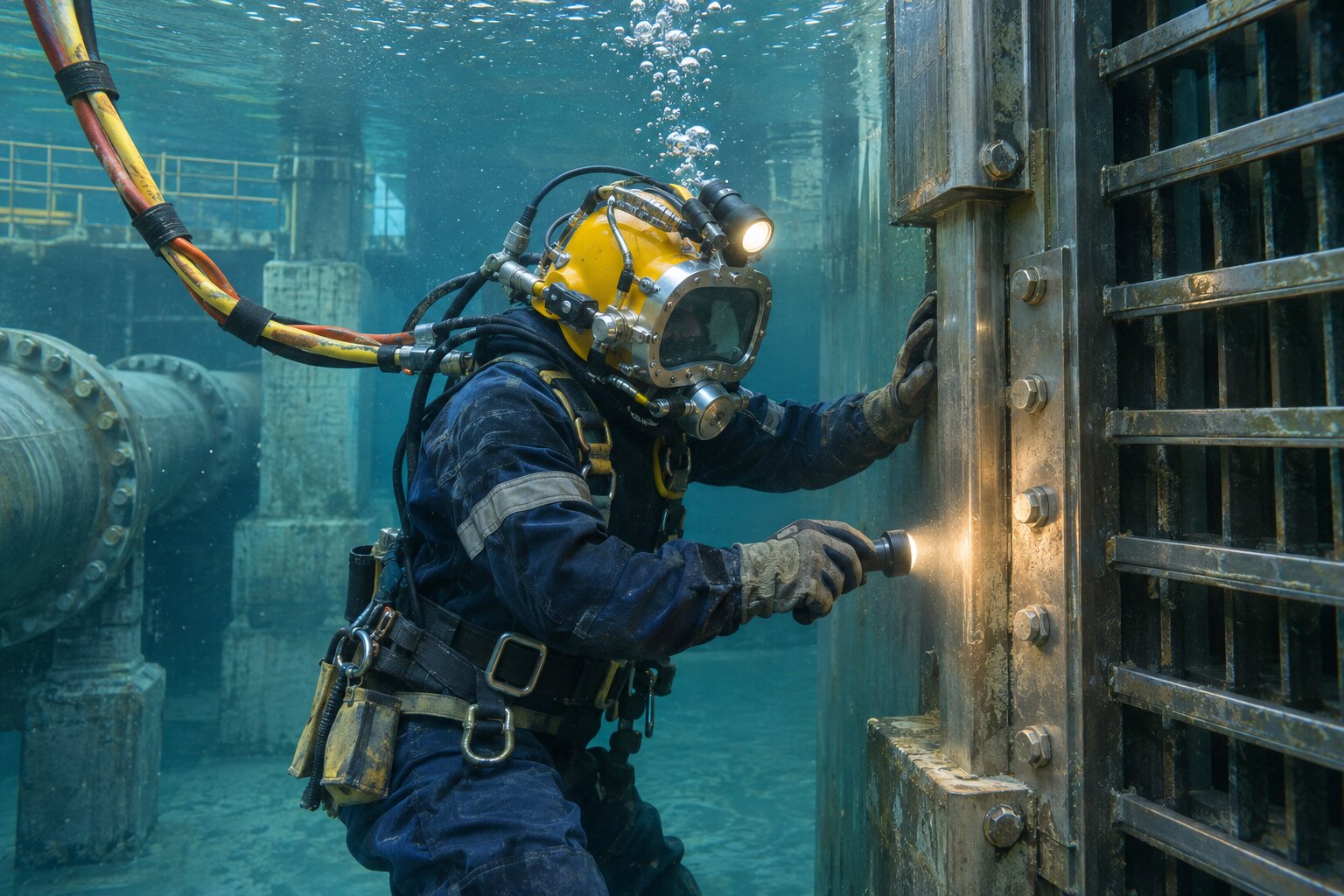
Commercial diving is industrial work performed underwater by a team. The diver may use surface-supplied breathing gas, a hard-shell helmet, an umbilical carrying breathing gas and communications, hydraulic or pneumatic tools, rigging, video systems, and other job-specific equipment. On the surface, tenders and supervisors manage the diver's equipment, communications, records, and emergency support.
The Occupational Safety and Health Administration's commercial-diving standard requires each dive-team member to have the experience or training needed for assigned tasks. Team members must also be trained in the relevant tools and systems, the diving mode, emergency procedures, CPR, first aid, and diving-related physics and physiology when they are exposed to or control hyperbaric conditions.
OSHA does not issue a personal commercial-diver license. In an archived interpretation of its training rule, the agency explained that documented training from an appropriate commercial, military, federal, or accredited program could demonstrate compliance. It also recognized a valid Association of Diving Contractors International certification card at the appropriate level as one way to document training. OSHA warns that the archived letter may no longer represent current policy, so candidates should rely on the current standard and the requirements of the employer performing the work.
Do not read that as permission to shop for the quickest card. An employer still has to decide whether your actual training and experience fit the assigned task.
How to evaluate commercial-diving training
Before you sign a school contract, ask questions that are harder than "Do graduates work underwater?"
- Is the program designed for commercial surface-supplied diving, not recreational instruction?
- Which current certification or training standard does the program meet?
- How many hours are spent on surface-supplied operations, tending, rigging, tools, inspection, emergency procedures, and documentation?
- Which credentials are included, and which require separate fees?
- Who verifies the school's job-placement claims?
- Where did the last graduating class actually go to work?
- Does the employer network include inland construction and power-generation contractors, or mainly offshore work?
- What physical screening is required before you commit tuition?
- Will you leave with complete training records, dive logs, medical records, and certification documents?
The phrase "underwater welding school" can be misleading. Welding is one useful specialty, but nuclear contractors also need divers who can inspect, measure, rig, clean, operate tools, manage equipment, and produce clear records. Choose a program for the whole trade, not for one dramatic skill.
Be cautious if a school promises a direct path from recreational scuba to spent-fuel-pool work, advertises a vague "nuclear diver certification," or cannot show where recent graduates found commercial-diving jobs. Nuclear sites provide assignment-specific access and training, but they do not replace the commercial-diving foundation.
Expect to earn trust as a tender/diver
Many new commercial divers spend substantial time tending before they receive complex underwater assignments.
That is not wasted time. A tender learns how the entire operation works: dressing the diver, checking the helmet and umbilical, managing lines, listening to communications, tracking the dive, maintaining equipment, staging tools, supporting emergency readiness, and noticing when something is wrong.
Good tending also reveals whether you are dependable when you are not the person in the water. Contractors remember the worker who keeps the deck organized, anticipates the next tool, protects the umbilical, records information accurately, and stays engaged through a long shift.
The DOE profile describes tender/diver as the normal starting point. Treat it as the first qualification stage, not as a hurdle you should skip.
Keep your own records from the beginning:
- employer and project dates;
- dive mode and team role;
- depth and bottom time when relevant;
- water conditions and visibility;
- equipment and tools used;
- inspection, construction, cleaning, or repair tasks;
- supervisor names and signatures where required;
- safety and technical training;
- medical and certification expiration dates.
Your future nuclear employer needs evidence it can verify, not a collection of stories that sound impressive.
Waterfront work and radiological pool work are different assignments
The term nuclear diver does not mean every dive carries the same radiation conditions.
Intakes, outfalls, ponds, and tanks
Many assignments involve plant infrastructure that happens to serve a nuclear station. A diver may inspect an intake, clear debris from a screen, document an outfall, work on a gate, apply a coating, inspect a condensate tank, or support maintenance in a cooling pond.
These jobs can involve serious industrial hazards without being high-radiation work. Flow, differential pressure, poor visibility, entanglement, confined geometry, heavy rigging, contaminated water, electrical equipment, and moving machinery can matter more than radiation.
Do not call that work routine. OSHA's Delta P diving alert warns that differential water pressure around drains, tunnels, pipes, and valves can create forces strong enough to trap a diver. The alert reported that five of six Delta P fatalities from June 2019 through July 2021 occurred at power-generation facilities.
The practical lesson for a job seeker is not to memorize an isolation procedure from an article. It is to recognize the quality of the employer's process. Ask who owns the dive plan, how the contractor and facility verify plant configuration and energy isolation, how changing flow conditions are handled, and whether the diver has clear stop-work authority.
Refueling cavities, fuel-transfer systems, and spent-fuel pools
Some specialized work occurs in water that contains or has contained irradiated components. This can include inspection, repair, foreign-material recovery, fuel-transfer-system support, or component work.
Water provides substantial shielding, but that does not make every location in a pool safe. Radiation conditions depend on the source, its position, the water depth, recent component movement, and the exact place the diver is expected to work.
The NRC's health-physics guidance on spent-fuel-pool diving says the required controls depend on the circumstances. It emphasizes that proper health-physics controls must be initiated when a diver performs underwater duties or when highly radioactive material in the pool is moved. An NRC notice on an overexposure during fuel-pool work illustrates why surveys, boundaries, communication, and continuous coordination are not paperwork around the job. They are part of the job.
The diver does not independently decide where the radiological boundary should be. Plant radiation-protection personnel establish the conditions, surveys, monitoring, protective equipment, dosimetry, approved work area, and stop points for the assignment.
If a recruiter talks about pool work as if it were just warm, clear water, keep asking questions.
What nuclear work adds to the trade
Commercial-diving competence gets you considered. It does not make you ready to walk into every part of a nuclear plant.
Plant access and fitness for duty
Depending on the assignment and access needed, a worker may complete identity verification, employment and education checks, fingerprints and criminal-history checks, drug and alcohol screening, a psychological assessment, security training, and continuing behavioral observation.
The NRC's access-authorization overview explains that the plant licensee is responsible for deciding who receives unescorted access. Contractors and vendors are included within the program when their work requires that access.
Access authorization is not a credential you obtain from the NRC before applying. It is also not automatically the same as a federal security clearance. The Nucjobs guide to commercial plant access and DOE clearances explains the difference.
Radiation-worker training and dosimetry
Workers assigned to radiological areas may need site radiation-worker training, dosimetry, protective-clothing training, contamination controls, and job-specific briefings. The NRC's information for radiation workers explains the federal training framework, worker dose information, and occupational limits.
Training does not turn the diver into a radiation-protection technician. It teaches the diver how to work within the site's program, understand the permit and boundaries, use the assigned monitoring equipment, respond to alarms or changing conditions, and communicate with radiation-protection coverage.
Procedures, quality, and documentation
A nuclear work package may define the component, prerequisites, boundaries, hold points, tools, materials, acceptance criteria, documentation, and post-work checks. The project may also include quality requirements for personnel, equipment, parts, inspections, and records.
You do not improve the job by quietly improvising when the underwater condition differs from the plan. You report what you see, protect the work boundary, and let the responsible plant and contractor personnel resolve the difference.
That habit is one of the strongest bridges from commercial diving into nuclear work.
What a nuclear dive day can look like
Every project is different, but the shape of a controlled dive is recognizable.
Before anyone enters the water, the dive team and facility review the job. They confirm the component, expected condition, plant configuration, hazards, roles, communications, tools, emergency arrangements, radiological controls when applicable, and the conditions that require the work to stop.
The team checks the helmet, breathing-gas system, communications, umbilical, harness, tools, cameras, and other equipment. Tenders stage the work so the diver is not improvising an equipment list from the water.
During the dive, the diver maintains communication with the surface and describes what is visible. A useful description is specific: location, orientation, dimensions, material condition, movement, deposits, damage, and how the actual arrangement compares with the drawing or expected configuration. Video helps, but it does not replace the diver's judgment and narration.
If a valve position, flow condition, component identity, dose rate, visibility, tool response, or physical obstruction does not match the plan, the diver reports it and the team stops or adjusts through the approved process.
After the diver leaves the water, the work continues. The team accounts for tools and material, downloads and labels video, records results, documents as-found and as-left conditions, identifies unresolved items, maintains equipment, and prepares the package the facility will use for engineering or maintenance decisions.
The most valuable diver is not the person who stayed underwater the longest. It is the person who helped the team finish the right scope safely and left a record the client can trust.
Skills that make a commercial diver more useful in nuclear work
You do not need every specialty before applying. You do need a clear base trade and evidence that your extra skills are real.
Inspection and reporting
Practice describing underwater conditions in a way that someone who cannot see the component can follow. Learn to reference drawings, mark locations, estimate or measure dimensions appropriately, capture usable video, and distinguish an observation from a conclusion.
Some projects require qualified visual examinations or other NDE methods. Those qualifications are separate from simply holding a diver card. The guide to nuclear NDE technician careers explains why method training, experience, examinations, and employer certification matter.
Rigging and mechanical work
Underwater work often involves loads, slings, shackles, hoists, fasteners, tools, gates, screens, piping, or structures. Rigging knowledge and mechanical judgment are valuable because water complicates visibility, communication, buoyancy, and control of a load.
Document the tasks you have actually performed. "Underwater construction" is too broad to help a recruiter understand your experience.
Cutting, welding, coatings, and tools
Underwater burning and welding can open specialized assignments, but they are not the only route into the field. Coating preparation, hydraulic and pneumatic tools, cleaning systems, bolting, concrete work, and repair support may be just as relevant to a specific contractor.
Do not list a school exercise as production experience. State where you trained, what process you used, and whether you have performed the task on a client job.
Sonar, cameras, and ROV support
Nuclear contractors also use cameras, sonar, acoustic imaging, stereo systems, and remotely operated vehicles to inspect conditions before or instead of placing a diver in the water. A diver who can support that equipment, interpret the scene, and turn the output into a useful record can contribute even when the safest dive is the one that does not happen.
One real nuclear-diver posting in plain English
When this article was reviewed in November 2026, Brennan's careers page listed a Divers (Nuclear Operations) role. A syndicated copy of the posting asked for five years of commercial-diving experience, a dive-school diploma, an ADCI-compliant physical signed by a physician, first aid and CPR, emergency-oxygen training, and the ability to travel full time. It preferred a current ADCI card, Hazardous Waste Operations and Emergency Response training, commonly called HAZWOPER, rigging experience, and a dive-supervisor card.
"ADCI-compliant physical" is the wording from this employer's posting. It is not an NRC license or a universal nuclear credential. Medical forms, examining-provider requirements, and renewal intervals can differ by employer, project, and certification program, so ask which form the contractor will accept before scheduling an exam.
The posting also emphasized a skill that candidates often overlook: describing and sketching underwater findings accurately for topside personnel.
Do not treat one contractor's requirements as the minimum for the whole industry. Treat them as a picture of a role that expects an experienced commercial diver, not a newly certified recreational diver and not necessarily a brand-new commercial-diving graduate.
If you do not meet that experience threshold yet, the useful question is not "How do I get around it?" It is "Which inland, industrial, marine-construction, or power-generation projects will build the missing proof?"
Build a resume around verifiable dive work
A nuclear-diver resume should let a hiring team understand your qualifications without decoding vague maritime language.
Start with a compact credential block:
- commercial-diver training program and completion date;
- current diver certification and level;
- current dive-physical date and expiration, if appropriate to share;
- CPR, first aid, AED, and emergency-oxygen dates;
- HAZWOPER, rigging, welding, inspection, coating, or other relevant credentials;
- passport, driver's license, union status, and travel availability when the posting requests them.
For each job, describe the environment, your role, the work, and the evidence.
Weak:
Performed commercial diving and underwater inspection.
Stronger:
Worked as a surface-supplied tender/diver on inland industrial projects, supporting intake-screen inspections, debris removal, hydraulic-tool work, underwater video documentation, and topside equipment checks in low-visibility water.
Weak:
Experienced with nuclear safety.
Stronger:
Completed site access and radiation-worker training for two power-generation assignments; worked to approved dive plans and plant isolation boundaries, maintained tool accountability, and delivered narrated video and written as-found results.
Include numbers when they clarify the work, not when they decorate it. Useful examples include crew size, project length, number of dives, component dimensions, water depth, tool type, inspection footage delivered, or the number of components inspected or repaired.
Never invent nuclear experience. A careful record of difficult commercial work is more persuasive than inflated language that falls apart in the interview.
Prepare six stories for the interview
Interviewers need to know how you behave when the water, equipment, or plan stops being cooperative.
Prepare one real example for each of these situations:
- You found a condition underwater that did not match the drawing, briefing, or expected setup.
- You stopped or delayed a dive because an isolation, current, visibility, equipment, or team condition was not acceptable.
- You communicated a complex underwater observation clearly enough for the surface team to act.
- You managed an umbilical, tool, rigging, or entanglement problem without creating a second hazard.
- You made a mistake, reported it promptly, and helped correct the work or record.
- You supported the team well as a tender or topside worker when someone else had the dive assignment.
Explain the situation, your responsibility, the decision you made, who you notified, and how the team confirmed the final condition. Avoid turning every story into a solo rescue. Nuclear work depends on teams that communicate early.
Search for the employer, not only the title
Utilities do not always hire their nuclear divers directly. Specialized contractors may provide the crews, equipment, supervision, certifications, quality program, and project management.
Search for titles and phrases such as:
- nuclear diver;
- commercial diver nuclear operations;
- tender/diver;
- inland commercial diver;
- power-generation diver;
- underwater inspection technician;
- nuclear diving supervisor;
- underwater services nuclear;
- intake and outfall diver;
- fuel-transfer-system diving.
Also search contractors that advertise nuclear, utility, marine-construction, hydroelectric, or industrial water services. Read their service pages before reading the vacancy. The service mix tells you whether the company mainly performs waterfront work, specialized radiological-pool work, or both.
Apply through the contractor's official careers page when possible. Save the posting as a PDF before it closes. You may need its exact requirements during screening or an interview.
The broader guide to getting a job at a nuclear power plant can help you organize the access and application side of the search.
Compare the whole offer
Nuclear diving can involve travel, compressed project schedules, long days, night shifts, weather delays, mobilization work, and gaps between assignments. A high hourly rate does not answer what you will earn across a year.
Ask the recruiter or hiring manager:
- Is this a permanent company position, a project hire, or a union dispatch?
- What percentage of the year did this crew travel during the last twelve months?
- Which hours are guaranteed, and which are only expected?
- When does pay begin for mobilization, badging, training, and site in-processing?
- Are travel days paid?
- How are per diem, lodging, mileage, airfare, rental vehicles, and baggage handled?
- What happens if a plant moves or cancels the scope after the crew mobilizes?
- Who pays for the dive physical, certification renewals, drug screening, and site training?
- Is overtime assigned by project, seniority, rotation, or supervisor decision?
- How often is the work performed at night or during a refueling outage?
- How much work is nuclear versus general marine construction?
- Which equipment is company-issued, and what must the diver provide?
- What is the path from tender/diver to working diver, lead, or supervisor?
Use the Nuclear Salary Guide for broad market context and the outage pay calculator to test a temporary assignment. Then compare the written offer with conservative assumptions. Do not build a household budget around overtime or per diem that is not guaranteed.
The guide to your first nuclear outage job covers travel, lodging, badging, schedule changes, and offer terms in more detail.
A practical 60-day entry plan
Days 1 through 10: audit your commercial-diving foundation
Gather your diploma, certification cards, dive logs, physical, CPR and first-aid records, equipment training, and work history. Mark every expiration date. Ask former supervisors now if you will need verification later.
If your only diving credential is recreational scuba, treat commercial diving as a new trade rather than a title you can add to your resume. Research legitimate commercial training and speak with working inland divers before taking on tuition.
Days 11 through 20: study the contractors and assignments
Build a list of contractors that serve nuclear plants, conventional power stations, hydro facilities, dams, industrial water systems, and marine construction. Note their locations, union relationships, travel expectations, service mix, and entry-level titles.
Separate waterfront work from radiological-pool work. They can belong to the same company but involve different experience, training, and project controls.
Days 21 through 35: close one real gap
Compare several current postings. If the repeated gap is rigging, inspection reporting, HAZWOPER, current CPR, or documented surface-supplied experience, address that gap through legitimate training or work.
Do not collect random online certificates because nuclear sounds credential-heavy. Employers care about credentials that support the actual assignment.
Days 36 through 50: rebuild the application
Rewrite your resume around dive mode, environment, tools, tasks, records, and safety decisions. Prepare the six interview stories. Create a one-page project list if your work history spans many short assignments.
Days 51 through 60: apply and evaluate
Apply through official employer sites. Track who received which resume, the posting date, travel requirement, physical and certification requirements, and access steps. Ask precise questions about the crew, projects, training, schedule, and written pay terms.
If the only available nuclear job is several steps above your current experience, keep building commercial-diving proof. Nuclear is a specialization, not a shortcut around the trade.
Frequently asked questions
Do I need a four-year degree to become a nuclear diver?
Usually not. Commercial-diver training, military diver training, documented field experience, current credentials, and the ability to meet employer and site requirements are more relevant. Some inspection, engineering, supervisory, or project-management roles may have additional education requirements.
Is a recreational scuba certification enough?
No. Recreational scuba does not by itself demonstrate commercial surface-supplied diving, tending, industrial tools, emergency procedures, rigging, work planning, or employer qualification for assigned tasks.
Do I need to be an underwater welder?
Not for every nuclear-diving job. Inspection, cleaning, mechanical work, intakes, screens, coatings, rigging, imaging, and documentation can all be part of the field. Welding can broaden your options when it is backed by real qualification and production experience.
Will my first nuclear dive be in a spent-fuel pool?
Do not assume it will. Contractors may require substantial commercial and nuclear experience before assigning specialized radiological-pool work. Many nuclear dives involve intakes, outfalls, tanks, ponds, screens, gates, and other plant infrastructure.
How much radiation do nuclear divers receive?
There is no useful universal number. Some waterfront assignments may involve little or no occupational radiation exposure, while specialized pool work is planned under site radiation-protection controls. Ask how the assignment is classified, what training and dosimetry apply, what the expected dose is for the specific scope, and how changing conditions are controlled.
Do nuclear divers need a security clearance?
Commercial nuclear-plant access is generally handled through the licensee's access-authorization program, not through an NRC-issued clearance. A job at a DOE site or another federal facility may have different requirements. Read the posting and ask which access program applies.
Is nuclear diving only outage work?
No. Some projects are tied to refueling outages or planned maintenance windows. Others support year-round waterfront infrastructure, inspections, repairs, tanks, environmental work, or emergent conditions. The contractor's service mix and project backlog matter.
Will I spend every workday underwater?
No. Commercial diving includes tending, mobilization, equipment maintenance, safety briefs, site in-processing, setup, standby time, documentation, and demobilization. Weather, plant conditions, access, and work-package readiness can change the plan.
Sources and further reading
- U.S. Department of Energy: Commercial Diver
- U.S. Department of Energy: 7 Nuclear Careers That Do Not Require an Engineering Degree
- Occupational Safety and Health Administration: Commercial Diving
- Occupational Safety and Health Administration: Qualifications of Dive Team
- Occupational Safety and Health Administration: Archived Interpretation on Training Required for Commercial Divers
- Occupational Safety and Health Administration: Keep Workers Alive During Diving Operations
- U.S. Nuclear Regulatory Commission: Information for Radiation Workers
- U.S. Nuclear Regulatory Commission: Applicability of Access Controls for Spent Fuel Pools
- U.S. Nuclear Regulatory Commission: Overexposure of Diver During Work in Fuel Storage Pool
- U.S. Nuclear Regulatory Commission: Access Authorization Programs
- U.S. Nuclear Regulatory Commission: Fitness-for-Duty Programs
- Brennan: Nuclear Diving and Underwater Support Services
The unusual part of this career is not that the work happens underwater at a nuclear plant. It is that two demanding systems have to work at the same time: a commercial dive team that can control the underwater job, and a nuclear work organization that can control the plant condition.
Build the diving trade first. Keep records that prove what you have done. Then approach nuclear work with enough confidence to contribute and enough humility to learn the site's rules.