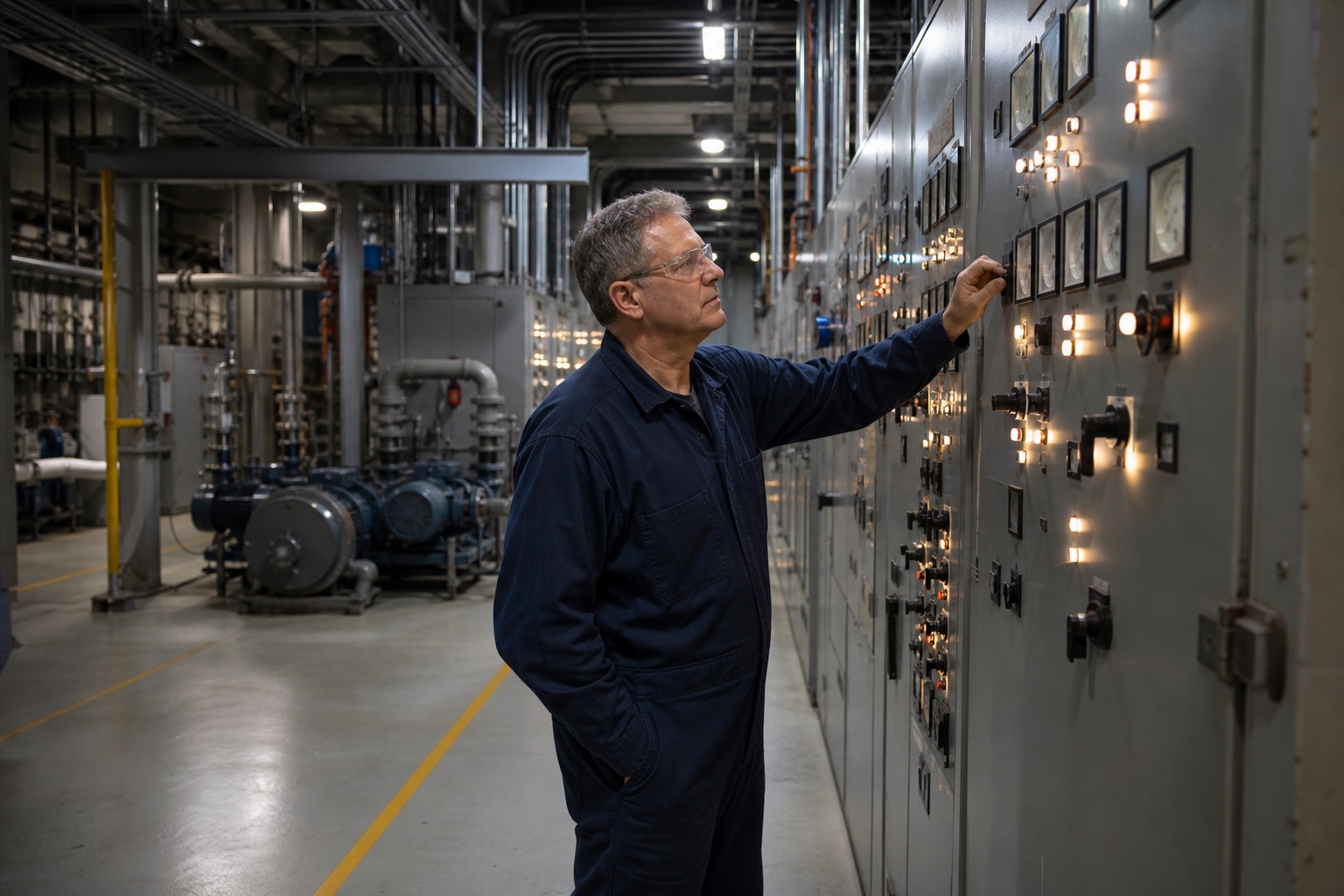
When operators shut down a nuclear reactor, the turbine slows and the main generator disconnects from the grid. The plant stops sending out electricity. Inside the plant, however, panels stay lit and important pumps keep running.
That is not a contradiction. The reactor has stopped producing power for customers, but it has not become cold or self-sufficient.
Fuel in the reactor is still producing heat. Operators still need to see temperatures, pressures, water levels, and electrical conditions. Pumps, valves, cooling systems, control equipment, and communications still have jobs to do. In many cases, the plant goes from being a large electricity producer to being an electricity customer.
That is why a shutdown reactor still needs a dependable chain of power sources.
The short answer
Inserting the control rods stops the self-sustaining fission chain reaction, but it does not instantly make the reactor fuel cold. Radioactive materials created during operation continue to decay and release heat. This decay heat falls over time, but it must still be removed.
Electricity powers much of the equipment used to move that heat out of the reactor. It also keeps plant instruments, controls, valves, alarms, communications, and other support systems available. After the main generator disconnects, the normal source is usually the offsite electrical grid, backed by onsite generators, batteries, and portable equipment.
A shutdown reactor has stopped making useful power. It has not stopped needing cooling, monitoring, and control.
Shutting down fission does not switch off the heat
Inside an operating reactor, uranium atoms split and release energy. The process also creates radioactive fission products. When operators insert the control rods, or when the reactor automatically trips, the sustained chain reaction stops very quickly.
The fission products remain radioactive, however. As they decay toward more stable forms, they continue to release energy as heat. The Nuclear Regulatory Commission calls this decay heat.
Decay heat drops sharply after shutdown and then continues to decline more slowly. The exact amount depends on the reactor's recent operating history and how long it has been shut down. It is much lower than the heat produced at full power, but even a small fraction of a large reactor's former heat output is still an industrial-scale heat load. The plant needs a reliable way to carry it away from the fuel.
This is the basic reason shutdown cooling matters. Heat moves from the reactor coolant through one or more cooling systems and eventually reaches the plant's ultimate heat sink. Depending on the site and design, that may involve a cooling tower, cooling pond, lake, river, or ocean. The details differ between pressurized-water reactors, boiling-water reactors, and individual plants, but the goal is the same: keep the fuel covered and temperatures within safe limits.
What still uses electricity after a shutdown
Not every motor and system keeps running. Operators choose the specific combination of pumps, valves, electrical sources, and flow paths required for the plant's current shutdown condition. Workers call that combination the plant's lineup. Several kinds of electrical loads remain important.
Pumps and heat-removal equipment
Many cooling arrangements depend on motor-driven pumps. Those pumps circulate water through the reactor or through connected cooling loops. Other motors move cooling water through heat exchangers or support the systems that reject heat outside the plant.
Some reactor designs and operating conditions can use natural circulation, meaning differences in water temperature and density help move coolant without a pump. Natural circulation can be valuable, but it does not make electricity irrelevant. Operators still need instrumentation and control power, and other parts of the heat-removal path may still need powered valves, pumps, or support systems. The NRC's work on shutdown heat-removal reliability reflects the importance of maintaining a dependable way to remove decay heat.
Valves, controls, and instrumentation
Operators need accurate information even when the reactor is not producing power. Instruments report reactor water level, temperature, pressure, electrical voltage, radiation conditions, and the status of equipment throughout the plant.
Electricity also powers control circuits, relays, protection equipment, valve actuators, alarm systems, and data displays. A large motor-operated valve may need alternating current, while a control circuit or instrument channel may use direct current.
The plant's electrical distribution system is divided into buses, which are distribution points that supply groups of connected equipment. Separating equipment among different buses allows the plant to protect important loads and provide redundant power paths as required by its design.
Spent fuel pool cooling
Fuel removed from the reactor continues to produce decay heat too. It is stored under water in the spent fuel pool, where the water provides cooling and radiation shielding. Pool cooling and cleanup systems circulate and condition that water. The pool is a separate plant load, and it may already contain fuel from earlier refueling outages before the current reactor shutdown begins.
Losing normal pool cooling does not mean the fuel immediately becomes uncovered or the water immediately boils. The large water inventory gives operators substantial time to restore cooling, and plants have backup ways to add water or remove heat. Operators still monitor pool temperature and water level closely, especially after recently discharged fuel has been added. The NRC's spent fuel pool overview explains the role of cooling systems and temporary backup equipment.
The systems that support people and plant operation
A safe shutdown also depends on more than reactor cooling. Depending on plant design and conditions, electrical power may support ventilation, room cooling, compressed air, water treatment, radiation monitoring, fire protection, lighting, security, communications, and control room habitability.
Some systems can be unavailable without creating an immediate safety problem. Others support equipment that must remain operable. That distinction is why plant procedures, technical specifications, operating licenses, and design documents matter. There is no single list of loads that applies unchanged to every reactor and every shutdown condition.
Where shutdown electricity comes from
Nuclear plants use layers of electrical supply rather than relying on one cord from the grid.
Offsite power from the grid
During normal operation, the main generator typically supplies much of the plant's own electrical load while also sending power to the grid. When the generator disconnects, the plant's design transfers those internal loads to an offsite source through transformers connected to the switchyard. The details vary by plant.
So after a routine shutdown, the plant may stop selling power and start drawing power from the grid. The NRC describes the offsite grid as the preferred source for the plant's auxiliary systems.
Emergency diesel generators and other onsite AC sources
If offsite power is lost, emergency diesel generators are designed to start and supply essential alternating-current buses. The precise equipment and sequence vary by plant. In general, the generators pick up selected loads rather than trying to power every building and motor on the site.
Because their job is time-critical, plants regularly test the generators and maintain their engines, starting systems, fuel supplies, cooling systems, and electrical connections. Operators also train for a generator that does not start or does not carry its assigned loads. Some sites have additional alternate AC sources.
Batteries and DC power
Station batteries provide direct-current power to critical instrumentation, controls, protection systems, switchgear controls, and other selected loads. Because the batteries are already connected to their DC buses, they can continue supplying those loads when normal AC power is lost. The NRC describes the role of safety-related DC power during normal operation, abnormal shutdowns, and accident conditions.
Batteries are important, but they are often misunderstood. A plant battery is not usually intended to run all of the large AC cooling pumps. Its job is to support the DC loads in the plant's design for a specified period. Inverters may use DC power to supply selected AC instruments or controls, but battery capacity is finite. Restoring an AC source remains an important priority during an extended event.
Portable generators, pumps, and connections
After the 2011 Fukushima Daiichi accident, the NRC required U.S. plants to strengthen their ability to maintain key safety functions when normal and installed backup equipment is unavailable. The industry's FLEX approach uses portable and diverse equipment such as generators, pumps, hoses, cables, fuel, and preplanned connection points.
The NRC says U.S. reactors now have portable backup equipment and installed resources intended to help maintain key safety functions during an extended loss of normal power and cooling. Plants also plan how to move, connect, protect, refuel, and operate that equipment under difficult site conditions.
A normal shutdown is not a station blackout
The phrase "the reactor shut down" describes the nuclear chain reaction. It says nothing by itself about whether the plant has electrical power.
A normal shutdown can occur with the grid available, the plant's buses energized, and cooling systems operating as expected.
A loss of offsite power means the normal grid supply to the plant is unavailable. The reactor will typically trip if it was operating, and onsite emergency AC sources are expected to start.
A station blackout has a narrower technical meaning. The NRC defines it as the complete loss of AC electrical power to the plant's essential and nonessential switchgear buses, involving the loss of offsite power together with the onsite emergency AC sources. It does not necessarily mean that every battery, instrument, or possible recovery source has vanished. It does mean the plant is in a serious condition because many systems used for decay heat removal depend on AC power. The NRC's station blackout history and definition provide useful context.
Keeping these terms separate prevents a common misconception. A routine reactor shutdown is not a blackout. A reactor can be safely shut down while the plant remains fully connected to the grid.
What changes as the hours and days pass
Decay heat decreases with time, so the plant's cooling needs change. Operators move through defined shutdown modes, adjust cooling lineups, place equipment out of service when allowed, and prepare for inspection or maintenance work.
During a refueling outage, the reactor vessel may eventually be opened and fuel assemblies transferred to the spent fuel pool. As fuel moves, part of the site's decay-heat load moves with it. Some plants offload the entire core for certain outages, while others do not. Either way, planners must pay close attention to the cooling systems, backup power sources, and redundant equipment that remain available while maintenance is underway.
Shutdown risk is not simply "high" or "low." It depends on current plant configuration, fuel location, available cooling paths, water inventory, electrical lineups, work in progress, and the time required to recover equipment. That is why outage schedules include far more than a list of maintenance jobs. They also manage plant conditions and equipment availability step by step.
What about reactors with passive safety systems?
Some newer reactor designs can use gravity, stored water, natural circulation, compressed gas, or other passive features to remove heat for a period without the same immediate dependence on large powered pumps. The NRC's overview of new nuclear plant designs gives examples of reactors that use these natural forces. Passive features can change how a plant responds to a loss of power.
Passive does not mean the entire site can operate forever without electricity. Instrumentation, valves, control systems, communications, cooling after the passive period, and many support functions may still require power. The right question is not whether a reactor is "passive" in the abstract. It is which safety function can be performed, for how long, under which conditions, and what must happen next.
Terms worth knowing
- Reactor trip or scram: A rapid shutdown of the fission chain reaction.
- Decay heat: Heat released by radioactive materials after fission has stopped.
- Offsite power: Electricity supplied to the plant from the transmission grid.
- Emergency AC power: Onsite alternating-current power, commonly supplied by emergency diesel generators, for selected essential loads.
- DC power: Battery-backed direct-current power used for selected controls, instruments, protection, and switching functions.
- Station blackout: Loss of offsite power together with the onsite emergency AC power supplied to the plant's switchgear buses.
- Ultimate heat sink: The water source or cooling arrangement used to reject heat so the plant can safely shut down and cool down.
- FLEX: Portable and diverse equipment used as part of strategies for an extended loss of normal power and cooling capabilities.
Why this matters to nuclear workers
Understanding shutdown power is useful well beyond the control room. Operators manage plant lineups and respond to changing conditions. Electrical and I&C technicians maintain the buses, breakers, relays, batteries, chargers, instruments, and generators that make those lineups possible. Mechanics maintain pumps, valves, diesel engines, and cooling equipment. Engineers analyze system performance and equipment availability. Outage planners sequence work so that maintenance does not quietly remove a needed layer of protection.
It also makes job descriptions easier to understand. Phrases such as "safety-related electrical distribution," "emergency diesel generator," "DC system," "shutdown cooling," "loss of offsite power," and "FLEX equipment" are connected parts of the same problem: keeping cooling, monitoring, and control available after the reactor stops producing electricity.
If that work interests you, browse nuclear operations jobs, browse instrumentation and controls jobs, or browse nuclear maintenance jobs. You can also read our guide to getting a job at a nuclear power plant for a wider view of entry paths.
The bottom line
A reactor shutdown ends the sustained fission reaction, not the plant's responsibility to manage heat. Decay heat remains in the reactor fuel and in recently removed fuel. The plant still needs cooling, instruments, controls, and trained people watching the equipment.
That is why nuclear plants are designed with layers of electrical supply: the grid, installed emergency generators, station batteries, and portable backup equipment. Each layer has a different job. Together, they help keep the plant stable while decay heat falls and the reactor moves toward a colder shutdown condition.
Sources
- U.S. Nuclear Regulatory Commission, Decay Heat
- U.S. Nuclear Regulatory Commission, Shutdown Heat Removal Requirements
- U.S. Nuclear Regulatory Commission, Effectiveness of Ultimate Heat Sinks
- U.S. Nuclear Regulatory Commission, Loss of Offsite Power
- U.S. Nuclear Regulatory Commission, Station Blackout
- U.S. Nuclear Regulatory Commission, Spent Fuel Storage FAQs
- U.S. Nuclear Regulatory Commission, Backgrounder on NRC Response to Lessons Learned from Fukushima
- U.S. Nuclear Regulatory Commission, Adequacy of Safety-Related DC Power Supplies
- U.S. Nuclear Regulatory Commission, Backgrounder on New Nuclear Plant Designs