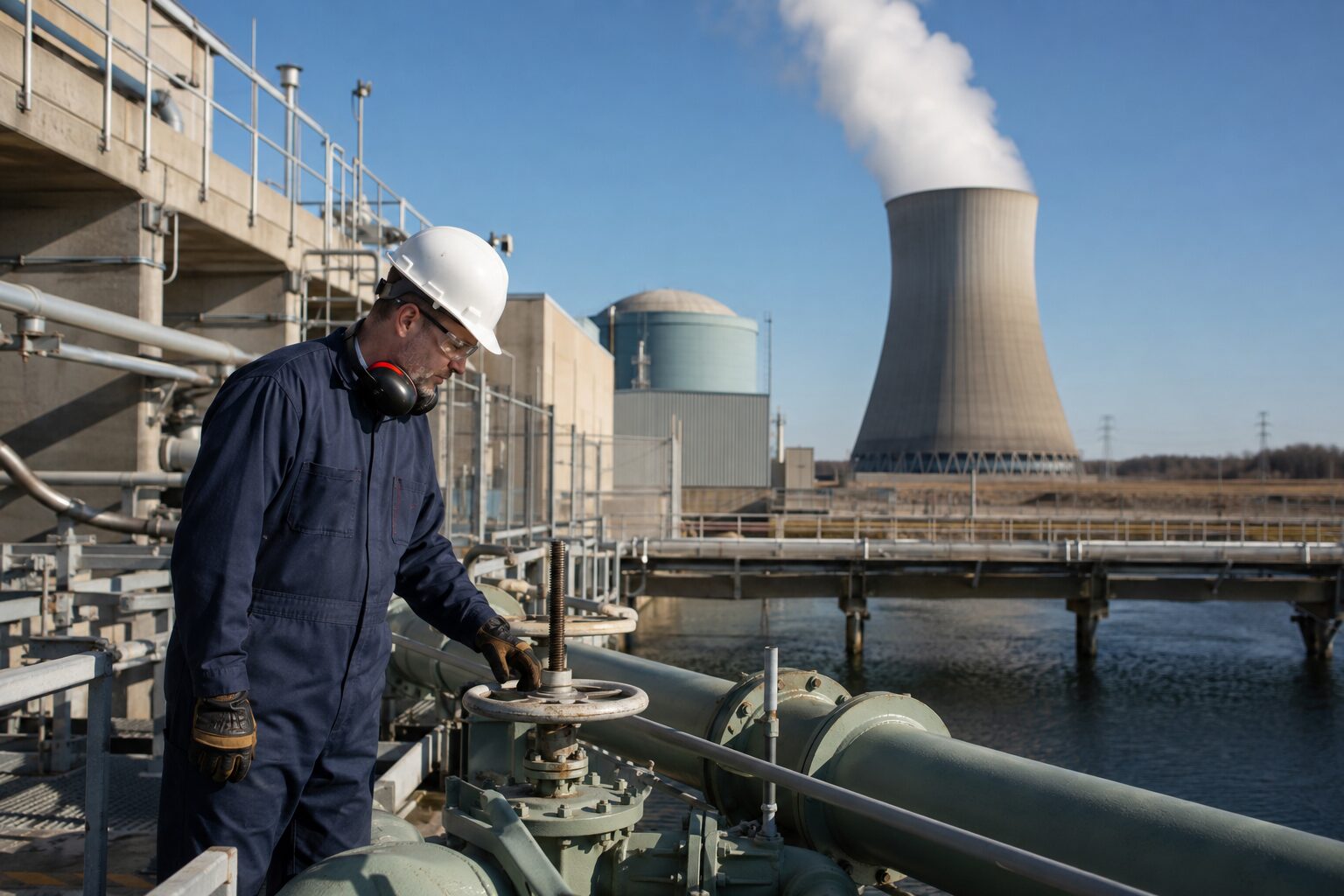
Stand near a nuclear plant on a cool morning and the cooling tower can look dramatic. A broad white cloud rolls out of the top, spreads with the wind, and sometimes hangs over the site. It is easy to see why people wonder whether they are watching reactor steam escape into the air.
They are not watching reactor steam. The visible plume comes from the plant's circulating-water system, not from the reactor or turbine steam system. It is mostly water that evaporated inside the tower and then condensed into tiny droplets as warm, humid air met cooler outside air. Radioactivity is not what makes the cloud visible.
That answer needs a little context, though. "Never radioactive" is too absolute. Nuclear plants manage radioactive water and permitted radioactive effluents. Some site-specific discharge arrangements use cooling-water or blowdown pathways, and equipment can leak. Any trace activity in tower water or exhaust would be site-specific, invisible, and evaluated through sampling and monitoring.
Here is how the systems actually fit together, what plant workers watch, and how to explain the plume without oversimplifying it.
The short answer
The white cloud above a main cooling tower is not smoke, and it is not steam vented from the reactor. It forms when a wet cooling tower transfers waste heat from circulating water to the atmosphere.
Inside the tower, some warm circulating water evaporates. The warm, moisture-laden air rises and leaves the tower. Water vapor itself is invisible. When that air mixes with cooler outside air, some moisture condenses into tiny suspended droplets, much like a cloud or visible breath on a cold day. That is the part people can see.
The circulating water normally stays physically separate from both the reactor coolant and the steam that drives the turbine. The cooling tower is the final heat-rejection step for that system. Depending on the plant's design and operating programs, circulating water or blowdown piping may also provide dilution or a discharge path for controlled liquid effluent.
The cooling tower plume is visible moisture from the circulating-water system, not reactor steam. Whether that water contains any measurable trace radioactivity is a separate, plant-specific monitoring question.
Cooling towers are not unique to nuclear energy. Coal and natural-gas plants, refineries, large factories, and some large building or data-center cooling systems use the same basic heat-rejection principle.
What the cooling tower is actually cooling
To understand the plume, start at the main condenser rather than at the reactor.
After steam has expanded through the turbine, it enters the condenser. The condenser is a large heat exchanger containing thousands of tubes. Cooler circulating water flows inside those tubes while turbine exhaust steam contacts the outside of them. Heat crosses the metal tube walls, but the two water streams are not supposed to mix.
As the turbine exhaust steam gives up heat, it condenses back into liquid water. That condensate is pumped through the plant's feedwater system and eventually returns to the steam source. The circulating water, now warmer, heads toward the cooling tower.
At a wet cooling tower, warm water is distributed over internal fill that creates a large surface area. Air moves through the tower, and a small portion of the water evaporates. Evaporation removes heat from the remaining water. The cooled water collects in a basin and is pumped back through the condenser to repeat the cycle.
The Nuclear Regulatory Commission's definition of a condenser describes this same heat path: turbine exhaust steam gives its heat to a circulating-water system, which rejects that heat through a cooling tower or directly to a body of water.
This is why describing the plume as "reactor steam" is misleading. The tower handles the water used to cool the condenser. It does not serve as an open chimney for the reactor or turbine.
The three water paths at a pressurized-water reactor
A pressurized-water reactor, or PWR, makes the separation especially easy to picture because the plant has three major water paths involved in power production and heat rejection.
- Primary coolant flows through the reactor core and carries heat to the steam generators. This water is kept under high pressure so it does not boil in the reactor.
- Secondary water and steam receive heat across the steam-generator tubes. The steam drives the turbine, condenses, and returns to the steam generators as feedwater.
- Circulating water passes through the main condenser tubes, absorbs waste heat from the secondary steam, and travels to a cooling tower or another heat sink.
Under normal conditions, the three paths remain separate. Heat crosses the walls of the steam-generator tubes and condenser tubes, but the water does not cross with it. The NRC's pressurized-water reactor overview walks through the primary loop, secondary steam system, turbine, and condenser.
The white plume comes from the third path.
What is different at a boiling-water reactor
A boiling-water reactor, or BWR, does not have steam generators. Water boils inside the reactor vessel, and that steam travels directly to the turbine. After leaving the turbine, it condenses and returns to the reactor as feedwater.
That means the BWR turbine and condensate systems have different radiological considerations from their PWR counterparts. It does not mean reactor steam is sent through the cooling tower.
The BWR's main condenser still keeps turbine exhaust steam on one side of the tube walls and circulating cooling water on the other. The circulating water carries heat away from the condenser and, at a closed-cycle plant, to the cooling tower. The NRC's Reactor Concepts training course shows the turbine, condenser, and circulating-water paths for both reactor types.
So the practical answer is the same at a PWR or BWR: the visible main cooling tower plume comes from circulating water, not from a direct reactor vent.
Why some nuclear plants do not have cooling towers
Every operating power reactor needs a way to reject waste heat, but not every plant uses the familiar hourglass-shaped towers.
A plant with a once-through cooling system draws water from a river, lake, or ocean, passes it through the condenser, and returns it at a higher temperature under environmental permit limits. Other sites use cooling ponds, canals, smaller mechanical-draft towers with large fans, or a combination of systems.
A plant with a closed-cycle cooling system recirculates most of its condenser cooling water. A tower or cooling pond removes heat before the water returns to the condenser. Makeup water replaces evaporation, drift, and water intentionally removed from the system.
The NRC's environmental review of nuclear plant cooling systems describes both once-through and closed-cycle arrangements. Cooling-water intakes and discharges are also regulated under environmental requirements, including the EPA's cooling-water intake rules.
The presence or absence of a huge cooling tower tells you how a site rejects heat. It does not tell you whether the site is nuclear.
Why the plume changes from day to day
The plume is shaped as much by weather as by plant conditions.
On a cold or humid day, warm saturated air from the tower reaches its dew point quickly. More moisture condenses into visible droplets, so the plume may look thick and travel a long distance. In warmer or drier air, the droplets can evaporate quickly and the plume may seem to disappear just above the tower.
Wind changes the plume's direction and how quickly it mixes. Calm conditions can leave moisture near the site. Freezing weather can contribute to local icing if droplets or drift settle on nearby surfaces. Operators consider these conditions in tower operation and site rounds.
The size of the visible cloud is not a dependable power meter. A large plume does not by itself mean the reactor is at unusually high power, and a small plume does not prove the plant is shut down. Heat load matters, but temperature, humidity, wind, tower design, and the number of operating tower cells can change what a person sees.
Vapor, plume, and drift are not quite the same thing
People often call the visible cloud "steam," which is understandable in ordinary conversation. Plant workers benefit from being more precise.
- Water vapor is water in its gaseous form, and it is invisible.
- The visible plume is formed mainly by tiny water droplets that condensed after warm, moist tower exhaust mixed with cooler air.
- Drift consists of small liquid droplets physically carried out of the tower by moving air. Drift eliminators inside the tower reduce that loss.
Drift matters because circulating water may contain dissolved minerals and approved treatment chemicals used to control scale, corrosion, and biological growth. Those are water-chemistry and environmental concerns, not evidence that the cloud is reactor steam. The NRC's cooling tower environmental review discusses evaporation, visible moisture, drift, blowdown, and the factors that affect them.
Can radioactivity ever get into circulating water or tower exhaust?
The honest industry answer is that the systems are designed to remain separate, and plants monitor them because equipment can leak.
Condenser tubes can develop pinholes or other defects. While the condenser is operating under vacuum, a tube leak generally pulls circulating water inward toward the condensate side rather than pushing turbine-system water out into the circulating-water system. Even so, a leak can affect condensate chemistry and plant performance, so operators identify and address it.
Other heat exchangers and site-specific connections create different possible leak paths. Plants use equipment isolation, radiation monitoring, chemistry sampling, alarms, procedures, and corrective-action programs to detect and manage abnormal conditions. The exact instruments, sample points, and response thresholds depend on the plant design and licensing basis.
There is another important distinction. Nuclear plants have controlled gaseous and liquid radioactive effluent pathways. Releases must meet regulatory limits and site controls. Depending on the pathway, plant programs provide treatment, sampling, monitoring, and dose calculation. At some sites, cooling water or a cooling-tower blowdown line provides dilution or carries a permitted liquid discharge toward its release point.
One NRC event notice from Harris Nuclear Plant, for example, described a cooling-tower blowdown line used for liquid-effluent dilution. That is a plant-specific configuration, not proof that every cooling tower contains plant effluent. It is a good reminder to check the actual system design before making an absolute claim.
Tritium, a radioactive form of hydrogen that can become part of a water molecule, is one radionuclide commonly discussed in plant water programs. If trace tritium is present in cooling-tower water, some tritiated water can follow the tower's evaporation, drift, or blowdown pathways. That possibility is why "never radioactive" is not a good industry answer. It does not turn the visible cloud into reactor steam, and a person cannot see radioactivity by looking at the plume.
It also helps to separate three different questions: Can an instrument detect radioactivity? Is a release permitted and controlled? What dose could result? Those are not interchangeable.
Sensitive instruments can detect trace concentrations. Plant staff compare the results with release controls, dose calculations, regulatory limits, and the requirement to keep releases as low as reasonably achievable, or ALARA. The NRC's environmental monitoring overview explains how effluent reports, environmental reports, licensee programs, and NRC inspections fit together.
Each U.S. commercial nuclear plant submits annual reports covering radioactive effluents and environmental monitoring. The NRC makes those plant-specific reports available to the public. The agency also explains how normal and abnormal liquid release paths are controlled.
This is the clearest accurate wording to use with a visitor or neighbor:
The visible plume is moisture from a cooling-water system, not reactor steam. Any trace radioactivity depends on plant-specific conditions and is determined by monitoring, not by the cloud's appearance.
How plant teams know what is in the water
No one relies on the color of a plume to judge radiological conditions. Plants use instruments, samples, operating data, and defined limits.
Chemistry technicians sample water systems and track properties such as conductivity, pH, dissolved solids, corrosion products, and treatment-chemical concentrations. A change in condensate chemistry can be an early sign of a condenser tube leak.
Radiation protection, radiochemistry, or chemistry personnel perform surveys, analyze samples, maintain radiological controls, and evaluate radioactive material in plant systems or effluent pathways. The exact division of work varies by site. Fixed process radiation monitors may provide continuous indication on selected pathways, while laboratory analysis can identify radionuclides or measure activity below an installed monitor's useful range.
Operators watch pump status, basin level, temperatures, condenser vacuum, flow, makeup, blowdown, and alarms. They adjust equipment in accordance with procedures and report unexpected conditions through the processes required by the site.
System engineers, maintenance teams, and I&C technicians trend performance and maintain the pumps, fans, valves, tubes, instruments, analyzers, and controls that keep the cooling and monitoring systems reliable.
Plants also conduct environmental monitoring around the site. The specific program is described in site procedures and licensing documents, and results are included in annual reports submitted to the NRC.
What to check at your own plant
A generic system diagram is useful for learning the heat path. It is not enough for a work decision or a plant-specific answer. If the question comes up during onboarding, a walkdown, or preparation for work, find these details in the approved documents for your unit:
- The system name and boundary. Plants do not all use the same acronym for circulating water, service water, or essential cooling water. Confirm which system reaches the tower and where its boundary with the condenser lies.
- The heat load the tower serves. The large main tower may serve the condenser, while a smaller mechanical-draft tower may support safety-related service water. Some units share structures or have helper towers.
- The makeup and blowdown routes. Identify the makeup source, where blowdown goes, and whether any permitted liquid-effluent path uses the system for dilution or discharge.
- The leak indicators. Learn which chemistry parameters, radiation monitors, condenser-vacuum indications, alarms, or sample results would point to an abnormal condition at your site.
- The controlling radiological documents. At a U.S. plant, review the applicable Technical Specifications and the Offsite Dose Calculation Manual, or ODCM. These documents address effluent controls, monitoring, and dose calculations. The annual radioactive effluent release report and radiological environmental operating report show what the plant actually measured and reported.
- The expected walkdown condition. Basin level, water distribution, pump and fan status, leakage, unusual noise or vibration, excessive drift, and icing can all matter. Use the site's procedure and acceptance criteria rather than diagnosing a tower from the plume alone.
The NRC publishes ODCM guidance for both pressurized-water reactors and boiling-water reactors. The details in your own plant's current licensing documents and procedures are the ones that govern your work.
What the main cooling tower does not do
The iconic main cooling tower is part of the plant's power-production heat cycle. Its normal job is to cool circulating water from the main condenser. It does not directly cool the reactor core.
That distinction becomes important during a shutdown. Even after the turbine and main condenser are no longer carrying the full power-production heat load, the reactor and spent fuel still need cooling. Plants use shutdown cooling, component cooling water, service water, residual heat removal, or other design-specific systems to carry that heat to an ultimate heat sink.
Some sites do have separate safety-related cooling towers or other structures that support essential cooling systems. Do not assume every tower on a site serves the main condenser. Drawings, system descriptions, equipment labels, and site procedures provide the answer for a particular plant.
For more on that part of plant operation, read why a nuclear plant still needs electricity after shutdown.
Terms worth knowing on the job
- Main condenser: The heat exchanger that turns turbine exhaust steam back into water.
- Circulating water: The large-volume water system that carries heat away from the condenser.
- Closed-cycle cooling: An arrangement that recirculates most cooling water after rejecting heat through a tower, pond, or similar system.
- Once-through cooling: An arrangement that draws cooling water from a body of water, passes it through the condenser, and returns it under permit conditions.
- Makeup: Water added to replace evaporation, drift, blowdown, and other losses.
- Blowdown: Water intentionally removed to control the buildup of dissolved solids and treatment chemicals.
- Drift: Liquid droplets carried out of a cooling tower with the exhaust air.
- Natural draft: Airflow created by the buoyancy of warm air in a tall tower.
- Mechanical draft: Airflow moved by fans, usually through a bank of smaller tower cells.
- Ultimate heat sink: The water source or cooling arrangement needed to support safe shutdown and cooldown, which may be different from the normal main-condenser cooling path.
Why this matters to nuclear workers
This question comes up in visitor centers and family conversations, but it is not just public-relations trivia. Understanding the heat path helps workers read system drawings, recognize equipment boundaries, and avoid confusing normal power-production systems with safety-related cooling systems.
It also helps when talking with family members, visitors, contractors, or people in the community. "It is just steam" is easy to say, but it skips the most useful explanation. A better answer identifies the circulating-water system, explains the condenser boundary, and acknowledges that radiological effluents are monitored through separate programs.
Cooling water also connects several nuclear careers. Operators align and monitor the system. Chemistry teams protect water quality and condenser performance. Radiation protection teams verify radiological conditions. Mechanics maintain pumps, valves, fans, and heat exchangers. I&C technicians maintain instruments and controls. System and environmental engineers track performance, permits, and long-term equipment health.
If you want to work with these systems, browse nuclear operations jobs, nuclear chemistry jobs, nuclear maintenance jobs, or instrumentation and controls jobs. Our guide to what a nuclear plant system engineer does explains another role that often owns cooling-water equipment and performance.
Common questions
Is the white cloud from a nuclear cooling tower radioactive?
It is not reactor steam, and the cooling-water system is normally separate from the reactor and turbine water. "Never radioactive" is still too broad because trace radionuclides can be present through plant-specific permitted discharge arrangements or leaks. Monitoring and sampling, not the plume's white appearance, determine whether radioactivity is detectable and what it means.
Does a larger white plume mean a larger radioactive release?
No. The visible cloud is condensed moisture, so its size is strongly affected by temperature, humidity, wind, and tower operation. Radioactive effluents are evaluated with monitors, samples, release records, and dose calculations. Plume size or color is not a radiological measurement.
Is it steam or water vapor?
In everyday language, people call it steam. Technically, water vapor is invisible. The visible white cloud is mostly tiny liquid droplets that formed when warm, humid tower exhaust cooled and condensed in the outside air.
Do all nuclear plants have cooling towers?
No. Some use once-through cooling from a river, lake, or ocean. Others use cooling ponds, canals, or smaller fan-assisted towers. Large natural-draft towers are one cooling design, not a required feature of nuclear power.
Can you tell how much power the reactor is making from the plume?
Not reliably. Plant heat load influences tower operation, but outside temperature, humidity, wind, tower configuration, and other factors strongly affect plume visibility.
Does the big cooling tower keep the reactor safe after shutdown?
The main tower normally removes heat from the power-production cycle through the condenser. Shutdown and emergency heat removal use design-specific systems and an ultimate heat sink. At some plants that heat sink includes a separate cooling tower, while other plants use a lake, pond, river, reservoir, or other arrangement.
The bottom line
The white cloud above a nuclear cooling tower is not smoke or reactor steam. It is visible moisture associated with a circulating-water system that carries waste heat away from the condenser.
The accurate explanation does not pretend that leaks, trace activity, or regulated effluents are impossible. Nuclear plants monitor those conditions through chemistry, radiation protection, operating, and environmental programs. The plume itself is a sign of heat being rejected to the atmosphere, not a visible stream of radiation.
Sources
- U.S. Nuclear Regulatory Commission, Condenser
- U.S. Nuclear Regulatory Commission, Pressurized Water Reactors
- U.S. Nuclear Regulatory Commission, Reactor Concepts Training Course
- U.S. Nuclear Regulatory Commission, Generic Environmental Impact Statement for License Renewal of Nuclear Plants, Cooling and Auxiliary Water Systems
- U.S. Nuclear Regulatory Commission, Generic Environmental Impact Statement for License Renewal of Nuclear Plants, Cooling Towers
- U.S. Nuclear Regulatory Commission, Radioactive Effluent and Environmental Reports
- U.S. Nuclear Regulatory Commission, Frequently Asked Questions About Liquid Radioactive Releases
- U.S. Nuclear Regulatory Commission, Backgrounder on Environmental Monitoring at Nuclear Power Plants
- U.S. Nuclear Regulatory Commission, Offsite Dose Calculation Manual Guidance for Pressurized-Water Reactors
- U.S. Nuclear Regulatory Commission, Offsite Dose Calculation Manual Guidance for Boiling-Water Reactors
- U.S. Nuclear Regulatory Commission, Harris Nuclear Plant Event Notification, April 2, 2009
- U.S. Environmental Protection Agency, Cooling Water Intakes